
Introduction
As enterprises expand their artificial intelligence adoption, many encounter performance degradation, slow model training, reduced throughput, and unexpectedly high IT expenditures. According to findings released on Oct. 5, 2026, by research and advisory firm Info-Tech Research Group from Arlington, Va., these performance challenges are frequently rooted in enterprise AI bottlenecks stem from workload misalignment rather than a simple lack of raw computing power.
Many organizations approach AI expansion by aggressively acquiring additional compute resources, yet fail to realize sustainable long-term value. Info-Tech Research Group emphasizes that greater long-term value depends on maximizing infrastructure utilization and aligning architecture decisions with specific workload requirements rather than merely purchasing more hardware. Successful AI infrastructure strategies begin with understanding the workload, not the technology.
What Changed
Info-Tech Research Group released a new blueprint titled ‘Define Your Target AI Infrastructure’. The framework is specifically designed to improve AI performance and scalability by helping infrastructure and operations leaders make more informed architecture and sourcing decisions through a workload-driven approach.
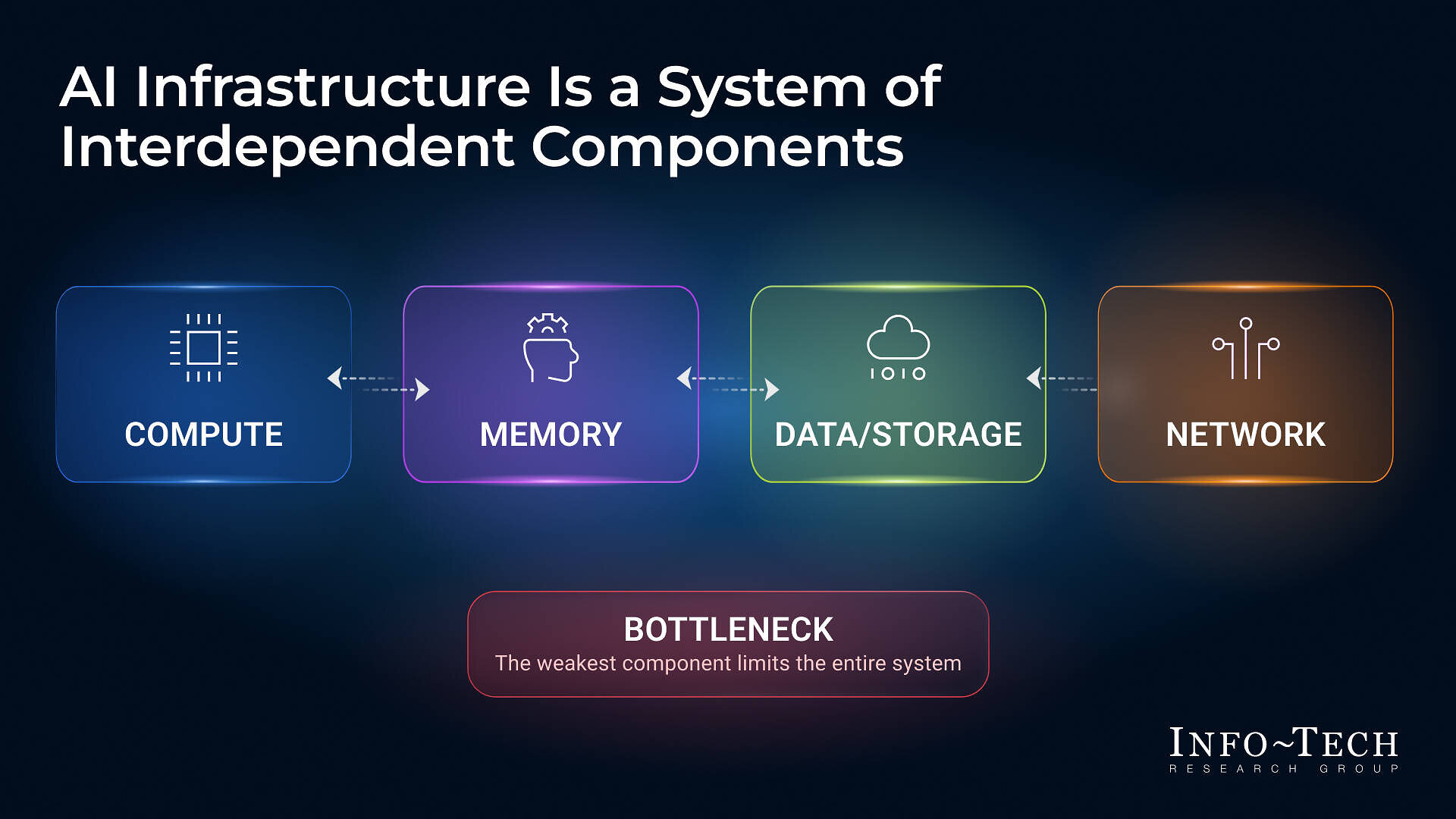
Rather than treating AI deployment as a standard procurement task, the framework addresses the complex reality of modern enterprise computing. AI infrastructure functions as an interconnected system where compute, memory, storage, networking, and physical infrastructure must work together seamlessly. When components operate out of balance, bottlenecks emerge immediately, inflating operational costs and stalling deployment timelines.
Context and Technical Explanation
To understand why traditional capacity planning often fails, infrastructure leaders must examine how AI traffic patterns diverge from legacy enterprise networks. Traditional enterprise network traffic is primarily user-facing, moving in a north-south direction that requires moderate bandwidth and greater latency tolerance. In contrast, AI traffic is predominantly compute-to-compute, creating heavy east-west traffic patterns that demand exceptionally high bandwidth and ultra-low latency.
Furthermore, different AI workloads place distinct demands on underlying infrastructure components:
- Model Training: Demands massive parallel compute and high-throughput, low-latency storage access.
- Inference: Requires predictable latency, rapid memory access, and efficient scaling.
- Retrieval-Augmented Generation (RAG): Relies heavily on fast vector database retrieval and rapid data pipelining.
- Agentic AI: Involves dynamic, multi-step execution paths that strain coordination across memory and compute.
- Edge AI: Operates under physical power, footprint, and connectivity constraints.
Because these workloads are highly variable and nonlinear, traditional capacity planning assumptions consistently fail, leading to misaligned investments and suboptimal performance.
Business Implications
Organizations that treat AI infrastructure as a balanced systems design challenge rather than a hardware acquisition exercise are better positioned to improve utilization, reduce operational risk, and maximize the business value of their AI investments.
When enterprises deploy hardware without assessing underlying workload characteristics, they often overspend on components that sit idle while other subsystems experience critical chokepoints. By shifting to a workload-driven architecture, IT leaders can control spiraling expenditures and build scalable environments capable of handling future technological shifts.
The Blueprint Methodology and Assessment Workbook
To guide organizations through this transition, Info-Tech Research Group structured its blueprint around five key phases:
- Assess workload characteristics.
- Align processor and infrastructure strategies.
- Identify constraints across components.
- Design balanced architectures.
- Establish operational strategies.
This methodology is supported by the AI Infrastructure Assessment Workbook. The workbook helps infrastructure teams profile their AI workloads, select from seven reference architecture patterns, define essential components, create vendor shortlists, analyze cost structures, simulate deployment scenarios, and generate a costed, validated summary.
Who May Be Affected
The release directly impacts infrastructure and operations leaders, enterprise architects, and chief technology officers across organizations scaling AI initiatives. Info-Tech Research Group works with over 30,000 IT, HR, and marketing leaders worldwide for nearly 30 years, providing advisory insights that help these decision-makers navigate complex operational transformations.
Limitations and What to Watch Next
While structured frameworks provide valuable roadmaps, organizations must adapt reference architectures to their unique enterprise constraints, legacy systems, and evolving AI models. As agentic AI and RAG architectures mature, infrastructure demands will continue to shift dynamically. Industry leaders should monitor how quickly enterprises adopt balanced system designs and whether these frameworks successfully curb unnecessary hardware expenditure.