
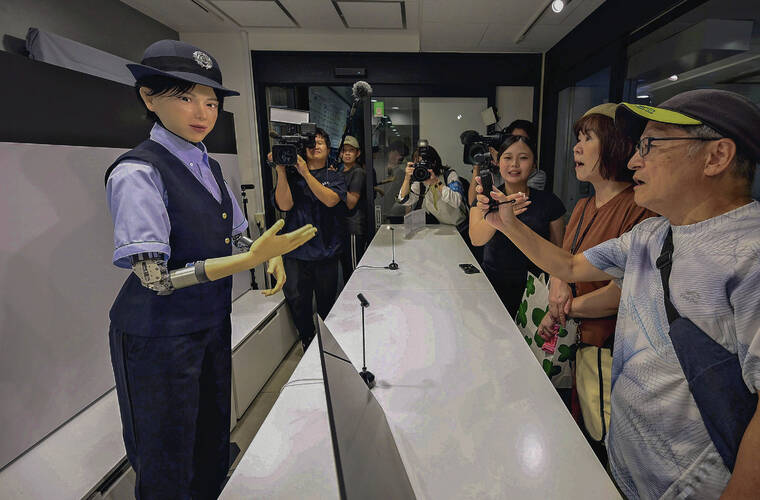
Osaka Metro Co. has officially begun testing an artificial intelligence-equipped humanoid station attendant at Umeda Station in Osaka City. The deployment places advanced generative AI directly into a high-traffic public transit hub, offering a glimpse into how transit operators might handle passenger inquiries and structural labor pressures in the future.
What Changed
Osaka Metro Co. installed a humanoid station attendant, nicknamed ‘Hinata’, in a high-traffic area of Umeda Station. On Aug. 31, the first day of the public test, the robot actively responded to questions from customers. During these initial trials, the system demonstrated its capability to handle conversational queries, such as when an inquiry about recommended takoyaki shops generated an answer directing passengers to shops on the Shin-Umeda Shokudogai street.
The robot is engineered to provide basic information including transfer details and nearby tourist attractions. It also features a display screen showing a code that, when scanned with a smartphone, provides supplemental route guidance including complex transfer information. Following the initial deployment at Umeda Station, the robot was slated for testing in September at another station in Osaka City.
Context and Background
This project brings together telecommunications infrastructure, academic research, and generative AI capabilities. The humanoid station attendant was jointly developed by KDDI Corp. and AVITA, Inc.
AVITA, Inc. is an AI startup specializing in AI humanoid robot solutions. Its president is Hiroshi Ishiguro, a professor at the University of Osaka known for his pioneering work in robotics and humanoids. Powering the conversational intelligence of the robot is Gemini, Google’s AI assistant. By integrating Google’s large language model technology with specialized hardware and software frameworks, the developers created an interactive agent capable of communicating smoothly with diverse travelers.
Why It Matters
For transit operators and municipal authorities, managing passenger inquiries efficiently requires significant staffing resources. Osaka Metro hopes the AI robot will serve as a practical solution to labor shortages, among other operational issues.
Furthermore, modern transit hubs serve global populations. Hinata addresses this by providing information in about 60 languages, including Japanese, English, and Chinese. This multilingual functionality aims to break down communication barriers for international tourists navigating complex urban rail networks.
Technical and Business Explanation
From a technical perspective, the deployment relies on cloud-connected large language models to interpret natural language queries and synthesize relevant local data. The use of Gemini enables the system to handle varied phrased questions—ranging from transit directions to local dining recommendations—without relying solely on rigid, pre-programmed decision trees.
On the business side, the collaboration allows KDDI Corp. and AVITA, Inc. to test their commercial humanoid solutions in demanding real-world environments. For Osaka Metro Co., the initiative forms part of a broader strategy to explore whether transit companies can provide new value to customers through humanoids, shifting routine informational tasks away from human staff.
Sector Impact and Implications
Initial public response to the deployment has noted its novelty. Observers have described the experience as novel and interesting. During the Aug. 31 test, the robot reportedly responded without a glitch to questions from customers.
However, broader implementation across the transit sector will depend heavily on sustained performance metrics, hardware durability in crowded public spaces, and passenger acceptance. The public transit sector closely watches such trials to determine whether humanoid attendants can successfully scale beyond controlled pilot phases.
Risks, Limitations, and Uncertainties
While early testing showed smooth operations, significant questions remain. Whether the AI robot could ultimately serve as a definitive solution to labor shortages is something the company is actively considering based on ongoing test results.
Limitations also exist regarding physical interactions and edge cases. While digital codes can bridge the gap for detailed route mapping, human attendants still handle complex safety emergencies, physical accessibility assistance, and nuanced operational disruptions that automated systems cannot easily resolve.
What to Watch Next
Stakeholders will monitor the outcomes of the September test at the second Osaka City station. Data gathered from Umeda Station and subsequent deployment sites will inform whether Osaka Metro Co. expands the trial, refines the language capabilities, or integrates additional station navigation features into Hinata and future humanoid attendants.
Attribution
This reporting is based on factual accounts detailing the rollout of the AI humanoid attendant project by Osaka Metro Co., KDDI Corp., and AVITA, Inc.