
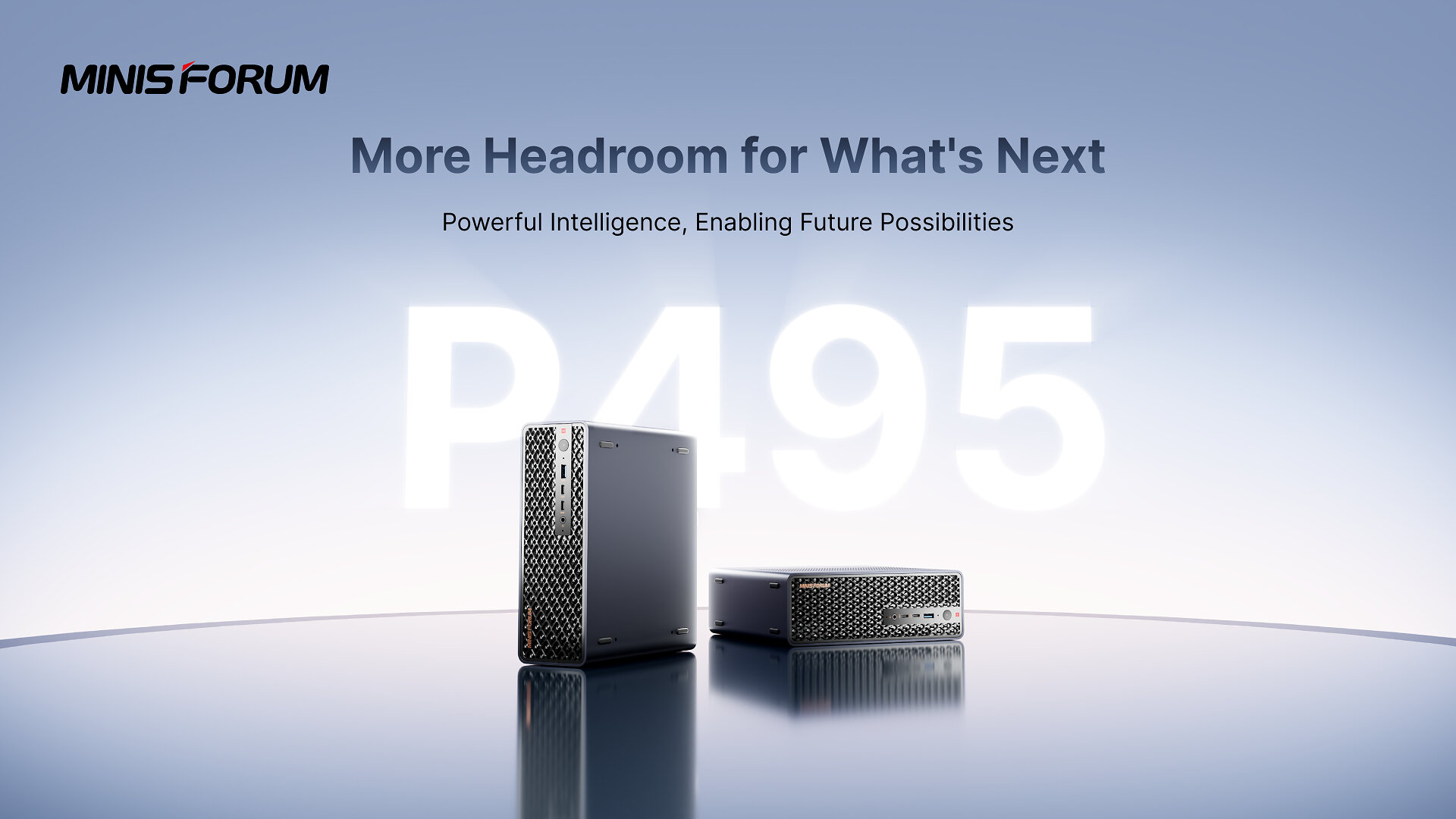
MINISFORUM has officially introduced the MS-S1 MAX-P495, marking a notable expansion of its local artificial intelligence computing strategy. Built around the high-performance AMD Ryzen AI Max+ PRO 495 processor and packing up to 192GB of unified memory, the new hardware system aims to transition heavy AI workloads from cloud-only infrastructure down to localized desktop environments, small clusters, and rack deployments. Founded in 2018, MINISFORUM serves more than 4 million users across over 100 countries with specialized product lines that include AI Agent NAS units, AI Mini Workstations, AI Mini PCs, and AtomMan Mini Gaming PCs. With the introduction of the MS-S1 MAX-P495, the company is pushing deeper into enterprise and research use cases where running massive language models locally is paramount.
What Changed
The core of the new hardware release is the integration of the AMD Ryzen AI Max+ PRO 495 processor. This advanced chip is built upon the Zen 5 architecture, incorporating 16 cores and 32 threads with clock speeds reaching up to 5.2GHz. It also features integrated Radeon 8065S Graphics to assist with parallel rendering and computational tasks.
In terms of artificial intelligence performance, the processor delivers up to 55 TOPS (Tera Operations Per Second) of NPU (Neural Processing Unit) performance, pushing total system AI compute capability to 131 TOPS. To support large workloads, the MS-S1 MAX-P495 configuration provides a maximum unified memory pool of 192GB, alongside a maximum allocatable VRAM capability of 160GB.
Technical and Business Explanation
The inclusion of a massive unified memory architecture fundamentally alters what local workstations can handle regarding large language models (LLMs). Traditional desktop graphics cards are frequently restricted by smaller dedicated VRAM limitations, forcing developers to rely on cloud services when working with parameter-heavy models.
By offering up to 192GB of unified memory and 160GB of allocatable VRAM, the MS-S1 MAX-P495 allows users to load substantial model parameters directly into fast system memory. According to company testing, the system supports running 300B-class large language models locally. Specific configurations demonstrated DeepSeek V4 Flash 284B (Q4) running at approximately 12 tokens per second.
Scaling beyond a single machine, testing showed that two 192GB units can form a dual-system cluster capable of running Qwen3.5-397B locally at approximately 16 tokens per second. Furthermore, a four-system configuration supported a 2U rack deployment to run DeepSeek-R1 671B Q4, which utilizes a 380GB size under Q4_0 quantization.
Context and Strategic Intent
According to MINISFORUM, the MS-S1 MAX-P495 helps bridge today’s AI era with the emerging era of Super Intelligence. The hardware is specifically engineered to extend local AI computing capabilities outward, moving beyond individual desktop setups into larger-scale deployments suited for corporate enterprises and dedicated research teams.
As organizations increasingly seek data privacy, reduced network latency, and independence from external API providers, local hardware solutions capable of executing hundreds of billions of parameters become vital infrastructure components. MINISFORUM’s strategy targets this exact enterprise requirement by packing data center-like model capacity into compact, scalable hardware footprints.
Business Implications and Sector Impact
The launch affects multiple sectors, including software development, enterprise data processing, and academic research. By lowering the physical footprint needed to run complex AI models, research teams can maintain strict data governance without leasing expensive cloud server slices.
The commercial availability details outline a pre-order price of US$9,249 for the 192GB RAM and 2TB SSD configuration, which features a temporary 20% discount reducing the cost to US$7,399. Shipping for the system is currently expected to begin in mid-October.
Risks, Limitations, and Uncertainties
While the hardware specifications present robust local processing power, users must navigate certain operational parameters. Running large-scale models locally demands substantial electrical power, thermal management, and adequate physical space—even with a compact form factor. Furthermore, while initial testing indicates viable token speeds for models like DeepSeek V4 Flash and Qwen3.5, multi-system clustering requires network synchronization overhead that can impact throughput.
Additionally, companies should note that shipping timelines carry minor uncertainties, with distribution officially expected to begin in mid-October.
What to Watch Next
Industry observers will monitor how enterprise and research buyers deploy the MS-S1 MAX-P495 in multi-unit clusters. Real-world benchmarks involving the 2U rack deployments for models such as DeepSeek-R1 671B will provide further clarity on the viability of local micro-data centers compared to traditional cloud infrastructure.