
As modern workspaces and mobile kits expand to include multiple smartphones, tablets, and portable computers, managing desktop organization and power delivery has become a daily challenge. Addressing this ongoing organizational bottleneck, hardware manufacturer Anker has recommended a curated lineup of five key hardware components engineered to streamline daily tech experiences while minimizing workspace cable clutter.
These hardware selections target common pain points such as tangled wires, limited wall outlets, and slow charging protocols across diverse device ecosystems. Each featured product in the lineup has achieved a rating of at least 4.8 out of five stars based on 90 or more buyer ratings on the Anker website, reflecting favorable user reception for their everyday reliability.
What Changed in Desktop Power and Organization
The landscape of peripheral power delivery has shifted toward high-density charging stations and versatile mounting hardware that reclaim desk space. Rather than relying on traditional bulky power bricks and unorganized wall sockets, hardware designs now incorporate multi-port topologies and modular clamping systems.
The Nano Power Strip Clamp offers a practical example of this shift by clamping directly onto the edge of tables between 0.6 and 1.8 inches thick. Utilizing integrated anti-slip pads and a tightening knob, the unit secures itself to workspace surfaces without permanent installation. It distributes connectivity across two USB-C ports—each capable of a maximum 70 watts—two USB-A ports, and six AC outlets distributed across multiple sides to accommodate various plug orientations.
Similarly, the Nano 6-in-1 Charging Station provides a low-profile desktop footprint measuring 3.6 by 3.8 by 0.7 inches. Attached to a 5-foot-long cord, it incorporates two USB-C ports that deliver 67-watt fast charging for single-port use, two USB-A ports with a maximum output of 12 watts each, and two AC ports. To ensure operational safety, the device integrates a seven-point safety system comprising fire resistance, over-voltage protection, over-current protection, and a dedicated temperature control system.
Mobile Charging and Wireless Stations
For mobile phone users and multi-device owners, wireless charging technology has also advanced to match wired speeds. A three-in-one wireless charger built for Apple devices offers up to 25-watt Qi2.2 fast charging when paired with the 45-watt power adapter included in the box.
According to technical performance metrics, this wireless charger can take an iPhone 17 Pro from dead to a 50% charge in 26 minutes. However, the 25-watt fast charging capability applies specifically to the iPhone 16 series and later iterations, while older models remain limited to 15 watts of power delivery.
Beyond sheer charging speed, form factor flexibility remains a core design priority. The wireless charging station is completely foldable and doubles as an adjustable phone stand. Users can tilt the stand from zero to 60 degrees while utilizing either landscape or portrait device rotation. The folded hardware measures a compact 3.74 by 2.38 by 1.22 inches, making it straightforward to pack into mobile bags.
High-Capacity Mobile Power Solutions
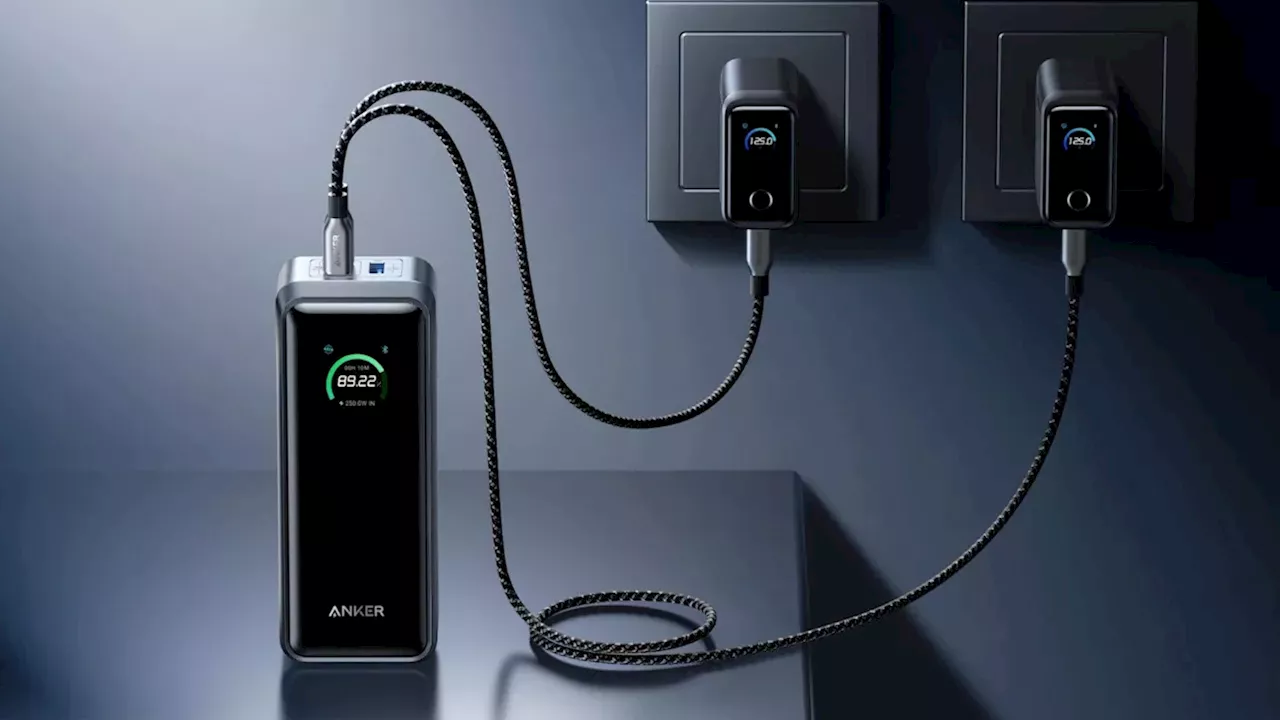
Power management outside the traditional office setting relies on high-capacity battery banks capable of supporting demanding mobile workstations. Anker’s high-capacity portable power bank delivers up to 300 watts of total output distributed across two USB-C ports and one USB-A port.
Performance benchmarks indicate the power bank can support up to 19 hours of video conferencing on a MacBook Pro M4 or up to 5.5 days of video streaming on an iPhone 17 Pro Max. Its individual USB-C ports can push up to 140 watts each, allowing the hardware to charge a MacBook Pro M4 Pro to 50% in 27 minutes, an iPhone 17 Pro Max to 50% in 22 minutes, and a Samsung S25 Ultra in 26 minutes.
To replenish its own internal capacity rapidly, the power bank supports dual input recharging. When plugged simultaneously into two separate 140-watt USB-C chargers, the unit can recharge to 50% capacity in 13 minutes and reach 80% in 40 minutes. The physical hardware measures 6.3 by 1.5 by 2.5 inches and weighs roughly the same as a 20-ounce water bottle.
Cable Management and Universal Interoperability
To address legacy hardware compatibility alongside modern ports, the lineup includes the Anker 321 Cable. This 35-inch three-headed cable features an integrated microUSB connector that serves as an adapter for Lightning and USB-C connections.
The cable supports data transfer functions, carries MFi-certification for Apple compatibility, and features a rated structural lifespan of up to 12,000 bends. It accommodates old legacy hardware such as flashlights and Bluetooth speakers, older Apple devices including AirPods 3 and the iPhone 14, alongside modern USB-C mobile hardware.
Business Implications and Sector Impact
For enterprise environments and remote professionals, upgrading peripheral hardware directly impacts daily workflow efficiency. The ability to fast-charge high-end laptops like the 13-inch MacBook Pro in under two hours via compact desktop strips reduces workspace clutter and eliminates the need to carry multiple distinct chargers.
Furthermore, high-capacity power banks offering up to 300 watts of total output provide reliable mobile backup for field technicians, remote journalists, and travelling executives who require uninterrupted uptime during transit. By consolidating multiple charging protocols into streamlined physical footprints, these accessories reduce downtime associated with slow peripheral charging.
Risks, Limitations, and Technical Boundaries
While the hardware features strong specifications, users must account for specific technical limitations before deployment:
- Device Compatibility Constraints: Maximum wireless charging speeds of 25 watts require iPhone 16 series hardware or newer; older smartphone models revert to a 15-watt ceiling.
- Recharging Infrastructure Requirements: Achieving the fastest power bank replenishment times (50% in 13 minutes) requires simultaneous access to two independent 140-watt USB-C chargers, which may not be readily available in all travel environments.
- Thermal and Power Distribution Limits: Single-port maximum outputs drop when multiple high-draw devices are plugged into the same power strip or battery bank simultaneously.
What to Watch Next
Observers of the mobile accessory market should monitor how Qi2.2 charging standards continue to scale across non-Apple Android ecosystems. As power density in portable batteries improves further, future iterations of mobile chargers may offer higher wattages in even smaller physical enclosures, continuing the industry-wide trend toward streamlined desktop and travel kits.