
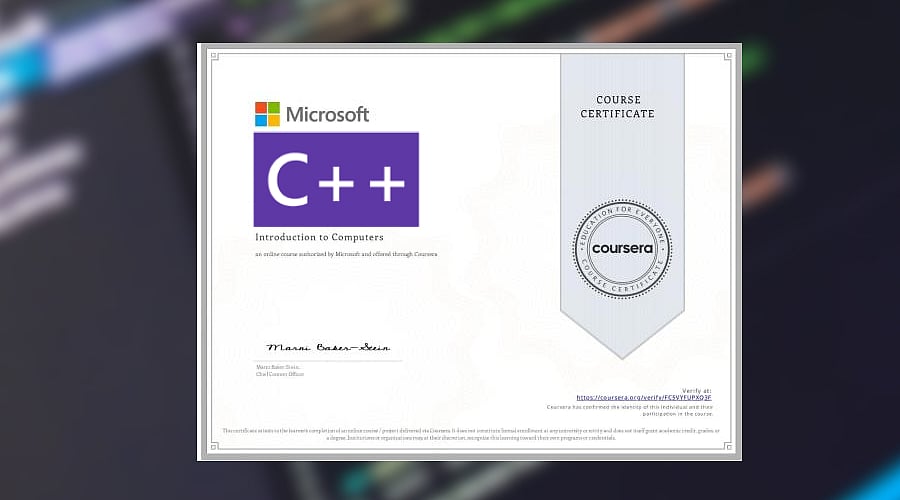
Microsoft has introduced the Microsoft Introduction to C++ Programming Professional Certificate, a new educational offering hosted on the Coursera platform designed to equip absolute beginners and career changers with foundational skills in software development, systems programming, and game development. As the technology sector continues to demand robust, high-performance programming skills, this structured curriculum aims to provide a clear pathway into professional software engineering without requiring prior coding experience.
What Changed
Microsoft has launched a structured, four-course professional certificate program delivered entirely online via Coursera. The curriculum is tailored specifically for individuals starting from scratch or those looking to pivot into new careers within technical domains like software development, systems programming, and game development. Rather than focusing solely on theoretical concepts, the program integrates hands-on elements, requiring learners to complete four distinct real-life projects designed for inclusion in professional portfolios.
Context and Structure
The program is structured to accommodate learners with busy schedules or alternative commitments. According to the course framework, the curriculum takes approximately four months to complete assuming an average commitment of five hours of study each week. Because it is hosted entirely online via Coursera, participants can progress through the materials at a flexible pace within the designated timeframe.
The academic structure comprises four individual courses. To ensure accessibility for a broad audience, the program does not require any prior professional programming background. Prospective learners only need a basic understanding of computers and a willingness to learn how to write code.
Curriculum and Technical Explanation
The syllabus covers a broad spectrum of modern software engineering topics, moving foundational concepts to advanced programming techniques. The core areas of instruction include:
- Basic C++ Programming: Introducing syntax, data types, control structures, and fundamental logic.
- Object-Oriented Programming (OOP): Teaching principles such as encapsulation, inheritance, and polymorphism to structure scalable code.
- Standard Template Library (STL): Providing practical knowledge of pre-built C++ templates, algorithms, and data containers.
- Multithreading: Exploring concurrent execution capabilities to build efficient, high-performance applications.
- Generative AI: Integrating modern artificial intelligence concepts into the programming workflow.
Throughout the learning journey, participants apply these technical concepts by building practical applications. Learners complete four real-life projects focusing on command-line tools, data processing, object-oriented programming implementations, and advanced C++ programming methodologies. These projects serve a dual purpose: reinforcing classroom learning and providing tangible evidence of capability for prospective employers.
Business Implications and Sector Impact
For individuals seeking to enter the technology workforce, professional certificates offer a recognized credential to validate newly acquired skills. Upon successful completion of the curriculum, learners receive a Microsoft credential that can be prominently displayed on a resume, curriculum vitae (CV), or professional networking platforms like LinkedIn.
This development aligns with broader industry trends where major technology companies partner with mass open online course providers to bridge technical skills gaps. By targeting absolute beginners and career changers, Microsoft is widening the talent pipeline for industries that rely heavily on systems programming and game development, sectors where C++ remains a cornerstone language due to its execution speed and memory management control.
Key Benefits
- Accessible Entry Point: Designed explicitly for absolute beginners with no professional programming background required.
- Portfolio Building: Includes four real-life projects covering command-line tools, data processing, object-oriented programming, and advanced C++.
- Flexible Online Delivery: Conducted entirely online via Coursera, allowing completion in about four months at five hours of study per week.
- Industry Credential: Provides a recognized Microsoft credential for resumes, CVs, and LinkedIn profiles.
Risks or Limitations
While the program provides a comprehensive introduction, prospective students must consider its boundaries. The course requires a consistent time commitment—estimated at five hours weekly over four months—and relies heavily on self-motivation due to its online format. Furthermore, while the curriculum introduces generative AI and multithreading, mastering advanced systems engineering concepts typically requires ongoing practice beyond an introductory certificate.
What to Watch Next
Observers of the online education and technology sectors will monitor how effectively certificate holders transition into full-time roles in software development, systems programming, and game development. As companies increasingly value portfolio projects and verifiable platform credentials alongside traditional university degrees, programs like this Microsoft offering on Coursera will continue to shape alternative pathways into technical careers.