
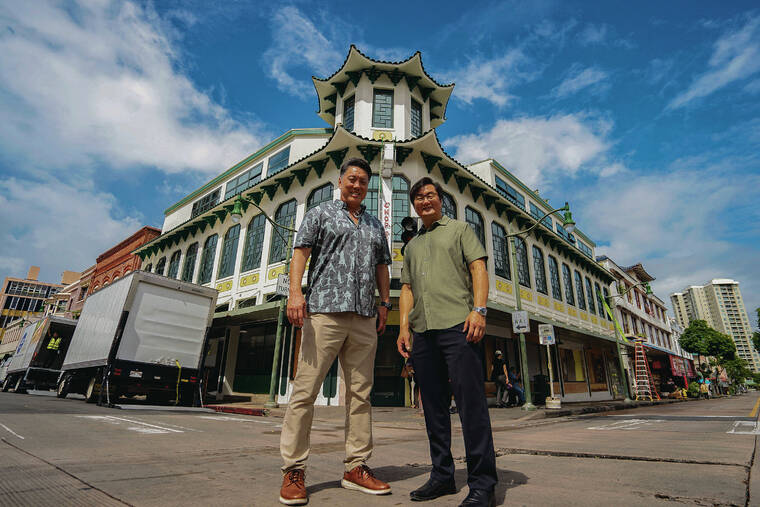
The historic Wo Fat Building, a landmark structure originally built in 1938 at Hotel and Maunakea streets, is set to undergo a major transformation. Investors Wai Tung “Ave” Kwok and Del Fujinaka purchased the property in August, launching a comprehensive redevelopment plan designed to blend community revitalization with historic preservation. The project will introduce affordable housing units, ground-floor retail spaces, and a dedicated cultural museum highlighting Chinatown’s vital role in shaping Hawaii’s Chinese community.
What Changed
Under the direction of Kwok and Fujinaka, the multi-story structure is currently undergoing a significant overhaul. The investors plan to open 22 affordable housing units on the second and third floors by February. These rentals will be reserved specifically for residents earning up to 80% of the area median income. Additionally, roughly 5,500 square feet of ground-floor restaurant and retail space is slated to open in either August or September 2027. A core component of the project includes restoring the Dragon Room, an octagonal third-floor space overlooking Maunakea Street featuring a distinctive dragon mural and decorative columns painted by Japanese American artist T. Takeuchi.
Context and Background
Developed originally by W.S. Ching in the late 1930s and designed by Chinese American architect Yuk Ton Char, the Wo Fat Building has deep historical roots in the region. The building’s landmark restaurant closed in 1994, after which much of the upper floors sat vacant for decades. Reflecting on the property’s turbulent history, Kwok noted that the building “has been failing since the 1960s. It was in the wrong people’s hands.” For many community members, the site holds immense sentimental value, with local connections recalling that their parents married or family members gathered there.
Kwok brings prior local real estate experience to the initiative, having purchased the circa-1926 Siu Building across the street in 2017 and serving as chairman of Maunakea Marketplace since 2023. In addition to the Wo Fat venture, Kwok and Fujinaka purchased 1580 Makaloa St. in July and also acquired the Hoku Paʻa Living Center on the North Shore.
Business Implications and Sector Impact
The total redevelopment of the Wo Fat Building is expected to cost between $3 million and $5 million. Kwok and Fujinaka view the introduction of affordable housing as a critical mechanism for Chinatown’s broader commercial revival. Furthermore, the restored Dragon Room will function as a museum, anchoring the cultural preservation efforts of the project. Kwok observed that “only the culture element has attracted the people to come here.”
Broader shifts in the immediate commercial landscape may also influence the project. Longevity International Enterprises Corp. sent tenants at the nearby Chinatown Cultural Plaza a notice on Sept. 18 stating that all leases would end by March 31 ahead of a planned redevelopment. Kwok expects this neighboring displacement to temporarily shift traffic patterns into the North and South King Street section and surrounding center hub, noting that tenants displaced from the plaza may eventually move toward the newly revitalized Wo Fat side.
Limitations and Security Context
While the project outlines concrete timelines for housing and retail delivery, certain commercial details remain flexible. Specifically, whether the commercial space will house specific businesses such as restaurants, coffee shops, or specialty retailers is noted merely as a possibility rather than a finalized tenant roster.
Safety and neighborhood perception remain key factors for regional commerce. Kwok credits the Chinatown Security Team in part for an 18% reduction in Chinatown crime reported by the Honolulu Police Department between 2023 and 2026. Emphasizing a community-focused approach to oversight, Kwok remarked, “My tenants are my eyes and ears,” describing the overarching strategy as “the storyline of looking at the underdog buildings and situations and how we are going to flip it for good.”
What to Watch Next
Stakeholders will be monitoring the completion of the second- and third-floor residential units ahead of their targeted February opening. Subsequent milestones include the commercial space deployment projected for late 2027, alongside the formal public opening of the restored Dragon Room museum.