
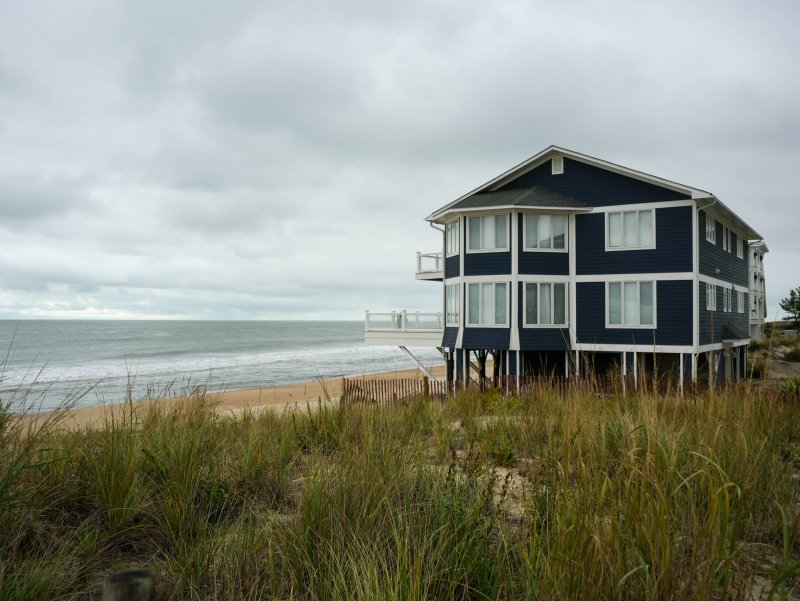
The Dewey Beach Town Council decided on Sept. 19 not to move forward with an ordinance that would have defined demolition and established a threshold for when building work constitutes a formal demolition. After more than three months of discussion, commissioners agreed that the proposed policy is unnecessary and could ultimately cause more harm to local homeowners than good.
What Changed
Under the rejected proposal, demolition would have been formally defined as the voluntary removal, destruction, dismantling, or replacement of a building or structure’s structural components by or on behalf of the property owner if the associated price tag reached 50% or more of the building’s current market value. To prevent property owners from bypassing the rule through phased renovations, the calculation would have factored in the cumulative cost of structural work completed over a rolling five-year period.
Following the Sept. 19 decision by the Dewey Beach Town Council, the municipality will not institute this structural valuation threshold. Consequently, property owners undertaking major renovations will not face these specific cumulative cost tracking mandates.
Context and Origins
Conversations surrounding the ordinance began after an incident in March, when a contractor working on a major home addition caused a legally nonconforming house to collapse due to an excavator mishap. Under municipal guidelines, demolitions are subject to stricter zoning and scheduling rules. If a grandfathered or nonconforming structure is officially deemed demolished, it loses its protected status and must be brought into compliance with current zoning rules, setbacks, height limits, and Federal Emergency Management Agency (FEMA) floodplain standards.
Despite the March incident, the town ultimately treated the home as demolished while still granting the owner approval to rebuild as originally planned. Jim Dedes, assistant town manager, noted that the accidental structural collapse earlier in the year was the sole occurrence of its kind during his 12 years with the town, supporting the conclusion that a broad policy change is unwarranted.
Sector Impact and Economic Implications
Local real estate values and municipal assessment data played a central role in the council’s deliberations. Sussex County assessed the values of most of Dewey Beach’s classic 1960s cottages in the low $300,000s last year. Under the 50% threshold outlined in the proposed ordinance, the demolition trigger would have been set at roughly $150,000 for these properties.
Commissioners and town officials reviewed how this cap would interact with standard construction and modernization expenses. For instance, lifting an older beach home to remodel and fully encapsulate its foundation can cost upward of $70,000 alone. Commissioner David Jasinski shared feedback from nearly all homeowners he spoke with, indicating that the expenses required to convert older properties into functional four-year-round homes while preserving their architectural character would regularly exceed the $150,000 limit.
Risks, Limitations, and Property Preservation
A primary concern raised by leadership was that the ordinance would inadvertently incentivize total destruction over thoughtful preservation. Commissioner Jasinski warned that the policy could push homeowners to tear down and rebuild completely rather than invest in saving older cottages. He noted that such an outcome would directly counteract the broader goals of the town’s comprehensive plan, which aims to preserve the character of the original 1960s cottages by maintaining owners’ willingness to pay for complex, phased renovations.
Limitations exist regarding exact cost projections. The specific cost estimates for converting older cottages are based on anecdotal homeowner feedback cited by Commissioner Jasinski rather than a formal town-wide engineering study.
Business Implications and Outlook
For local contractors, real estate developers, and homeowners, the decision removes a layer of regulatory friction and cost calculation uncertainty. Property owners planning updates to nonconforming structures will continue to operate under existing municipal protocols rather than a rigid 50% valuation threshold or a five-year cumulative tracking mechanism. Town leadership has signaled a return to status quo governance, indicating that existing oversight mechanisms remain adequate for managing structural construction projects in Dewey Beach.