
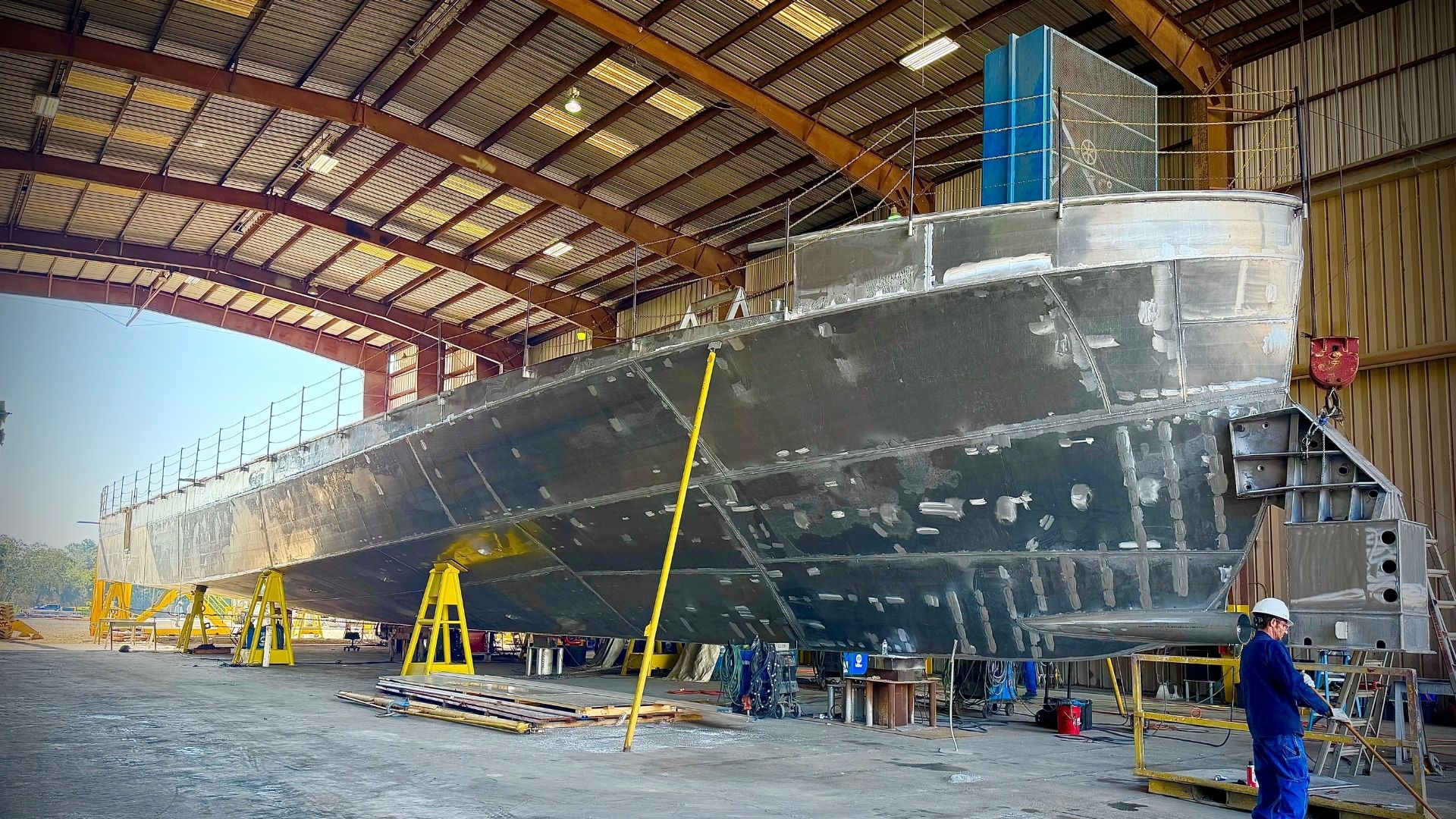
The U.S. Navy has awarded a significant contract to HII, America’s largest shipbuilder, to construct 10 ROMULUS autonomous surface vessels. This major defense tech development marks a decisive step forward for the Medium Unmanned Surface Vessel (MUSV) program, transitioning the initiative from evaluation and prototyping into full-scale production. As naval forces around the world increasingly look toward unmanned systems to patrol open waters, gather intelligence, and reduce risks to human personnel, the ROMULUS contract highlights the rising importance of scalable autonomous maritime infrastructure.
What Changed
Under the new contract, HII will build 10 ROMULUS unmanned surface vessels (USVs) for the U.S. Navy’s Medium Unmanned Surface Vessel program. This agreement follows the successful completion of the MUSV program’s evaluation phase, which included rigorous operationally representative tests. According to the company, this award allows HII to shift directly from development and testing toward manufacturing a robust fleet of autonomous vessels.
Prior to securing this production contract, HII laid the groundwork for manufacturing throughout 2025 by securing key partners, vital suppliers, necessary production capacity, and physical infrastructure. The build process relies on a unique distributed production model designed to scale output as demand grows.
Technical Core: Odyssey Autonomous Control Solutions
At the technological heart of the ROMULUS vessel is HII’s Odyssey Autonomous Control Solutions (ACS). This modular autonomy system is engineered to handle navigation, onboard system and payload management, and coordination between manned and unmanned platforms with limited human intervention.
Odyssey ACS features an open architecture. This design is specifically intended to allow new sensors, command-and-control technologies, and artificial intelligence algorithms to be seamlessly integrated as they become available. By utilizing a modular, open-architecture approach, the Navy ensures that the ROMULUS fleet can adapt to evolving technological capabilities without requiring complete redesigns of the underlying hull or propulsion systems.
Testing and Validation
During the evaluation phase leading up to this contract, ROMULUS underwent stringent trials in the Gulf of America. Over a 13-day period, the vessel was tested under operationally representative conditions closely monitored by the Navy.
Key performance milestones during these tests included a long-endurance mission simulation that covered 420 nautical miles in 28 hours. Throughout this simulation, the platform successfully met all established success criteria, demonstrating its reliability, endurance, and navigation autonomy under realistic operational constraints.
Supply Chain and Distributed Production
To manufacture the vessels efficiently, HII is employing a collaborative distributed production model. HII developed ROMULUS in coordination with several technology and maritime partners, including Applied Intuition, Greenroom Robotics, Rodi Marine, Beier Integrated Systems, and Incat Crowther.
For physical manufacturing, HII is utilizing Gulf Coast partners in Louisiana, specifically Breaux Brothers Enterprises, Halimar Shipyard, and Bayou Metal Supply & Manufacturing. Additionally, HII announced a 10,000-square-foot expansion of its existing 40,000-square-foot unmanned manufacturing production campus. This expanded facility will support the ongoing production of both REMUS unmanned underwater vehicles (UUVs) and the new ROMULUS USVs. HII notes that it has previously delivered more than 750 REMUS UUVs to customers in over 30 countries.
Business Implications
From a defense manufacturing perspective, the transition to a distributed production model represents a strategic business approach. HII states that this network of regional partners and expanded facilities could increase production throughput and establish a repeatable, scalable process for building ROMULUS vessels as future naval demand expands.
By decentralizing portions of the manufacturing process across specialized Louisiana shipbuilders and suppliers, HII can leverage existing regional maritime infrastructure rather than attempting to centralize all heavy manufacturing within a single corporate shipyard.
Sector Impact and Who May Be Affected
The adoption of medium unmanned surface vessels signals a broader shift in naval defense procurement. Traditional shipbuilders, prime defense contractors, and specialized autonomy software developers are increasingly intersecting. Companies providing software, navigation algorithms, and modular sensors—such as partners Applied Intuition and Greenroom Robotics—stand to gain visibility as open-architecture maritime systems become standard.
Personnel in naval operations will also be affected, shifting from direct physical navigation and onboard watch-keeping toward remote supervision, payload management, and coordination of mixed fleets of manned and unmanned assets.
Limitations and Uncertainties
While the evaluation phase demonstrated strong results over a 420-nautical-mile simulation, long-term operational durability under extreme sea states, prolonged deployment durations, and contested electronic warfare environments remain critical variables. The research brief notes no specific public uncertainties or limitations beyond standard deployment parameters, but open-architecture autonomy and integration of evolving AI algorithms inherently require continuous cybersecurity oversight and rigorous software validation.
What to Watch Next
As HII ramps up its 2025 preparation efforts and utilizes its expanded manufacturing footprint, industry watchers will monitor the delivery timeline of the 10 ROMULUS vessels. Key indicators of success will include the integration pace of new sensors via the Odyssey ACS open architecture, the operational efficiency of the Louisiana distributed production model, and subsequent follow-on contracts from the U.S. Navy as the MUSV program matures.