
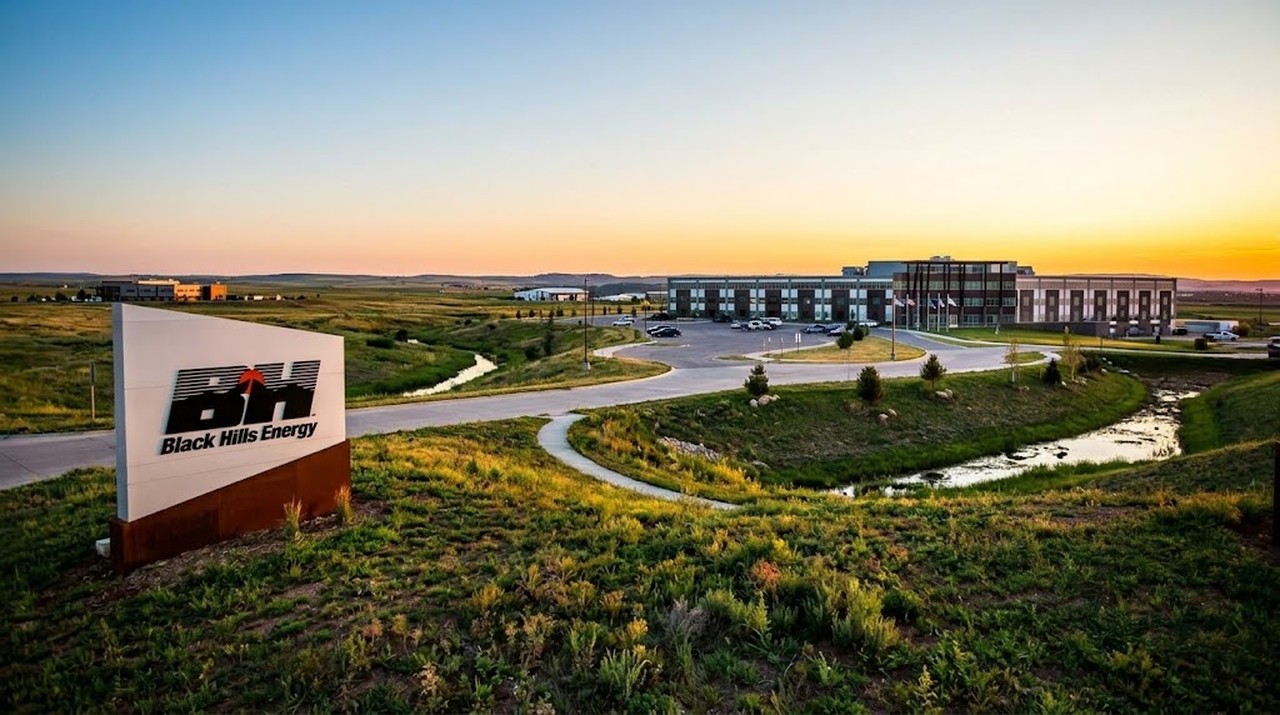
Energy Stock Black Hills Corp. (NYSE: BKH) soared significantly in market trading following the announcement of a landmark long-term infrastructure agreement with technology giant Google. Black Hills Corp. shares traded at $77.73, rising $6.99 or 9.88%, on heavy volume exceeding 1.6 million shares while hitting a morning high of $77.95.
The sharp market reaction reflects investor enthusiasm surrounding a major corporate commitment linking utility infrastructure to modern technology expansion. According to reports covered by Investorideas.com on October 7, 2026, the agreements mark a major development for the regional energy provider and its operational capacity in Wyoming.
What Changed
Black Hills Corp. announced that it signed definitive agreements effective September 30, 2026, with contractual terms stretching through 2048, to serve a planned Google data center located in Cheyenne, Wyoming. These agreements consist of a Large Power Contract Services Agreement (LPCSA) and a Generation Facilities Agreement (GFA).
Under the terms of the newly established framework, Google will bear all costs associated with serving the planned data center throughout the entire life of the project. The project’s resource mix spans 2.7 GW, which includes necessary reserve margins. Service to the facility is scheduled to begin in late 2027 and steadily ramp up to peak load capacity by 2030.
To accommodate the massive power demand, Black Hills plans to invest $1.8 billion between 2027 and 2029 to construct 564 MW of company-owned natural gas generation capacity at the Cheyenne Prairie Generating Station location. Additionally, Google provided Black Hills with $399 million in refundable advances to facilitate long lead-time equipment procurement under a generation reservation agreement. Black Hills expects to reimburse these advances by June 30, 2027.
Business Implications
The business and financial implications of the long-term agreements are substantial for Black Hills Corp. Company projections indicate that the project will provide approximately $150 million of net income in 2030. Furthermore, the initiative is expected to deliver approximately $2.4 billion of unlevered free cash flow, calculated net of the initial $1.8 billion generation capital investment.
Linn Evans, representing corporate leadership, commented on the strategic alignment of the partnership: “We are pleased to support Google’s planned investment in Wyoming while remaining firmly committed to providing safe, reliable, and cost-effective service to every customer.” Evans added that “the agreements demonstrate how innovative energy solutions can support economic growth while ensuring existing customers are protected.”
The financial scope of the arrangement provides Black Hills with predictable, long-term cash flow generation through 2048, backed entirely by a major technology enterprise that assumes the full financial cost of the utility service expansion.
Sector Impact and Regional Development
The partnership highlights a broader nationwide trend where major cloud computing and artificial intelligence infrastructure providers directly engage with regulated utilities to secure dedicated power generation resources. Data centers require uninterrupted, high-capacity electricity, prompting inventive contracting structures between technology companies and energy providers.
Beyond corporate financials, the project is expected to generate significant positive local effects. According to project claims, the development will create jobs, strengthen regional infrastructure, and contribute meaningfully to Wyoming’s long-term economic development.
The expansion of the Cheyenne Prairie Generating Station demonstrates how regional utilities can scale up operations to match the rigorous demands of next-generation computing facilities without placing undue financial strain on local ratepayers.
Risks and Limitations
While the market response has been overwhelmingly positive, stakeholders must consider several inherent limitations and projections tied to the agreement. Notably, the project’s financial outcomes, projected cash flows, and anticipated net income figures are forward-looking projections based on expected ramp schedules and future development milestones.
Any unexpected delays in construction between 2027 and 2029, or shifts in the projected 2030 peak load ramp schedule, could alter the realization of the estimated $150 million net income for 2030 and the $2.4 billion in unlevered free cash flow. Furthermore, long-term execution through 2048 depends on continuous regulatory compliance and successful equipment procurement supported by the initial $399 million refundable advance structure.
What to Watch Next
Investors and industry observers will monitor several upcoming milestones as the project transitions from contract execution to physical construction:
- The reimbursement timeline for the $399 million refundable advance, scheduled to be completed by June 30, 2027.
- The commencement of the $1.8 billion capital investment phase spanning from 2027 through 2029 for the 564 MW natural gas generation construction at Cheyenne Prairie Generating Station.
- Progress toward the initial service activation date in late 2027.
- Subsequent load ramp milestones leading up to the targeted peak load in 2030, which will trigger the projected $150 million net income milestone.