
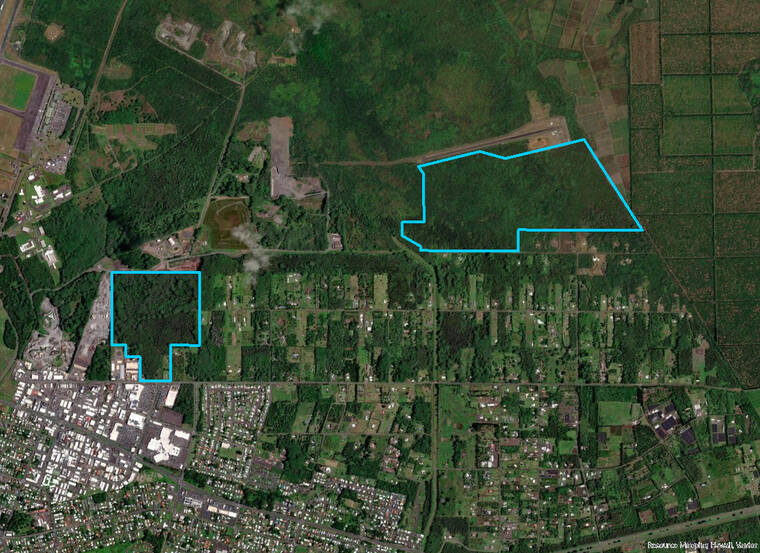
The Department of Hawaiian Home Lands (DHHL) has unveiled a conceptual plan for a new business park on approximately 146 acres along Railroad Avenue in the Panaʻewa area of Hilo. The proposed commercial, retail, and industrial development aims to generate long-term revenue to support the agency’s primary homesteading initiatives while creating local job opportunities.
DHHL Land Agent Andrew Sante presented the proposed project at a community meeting held in Keaukaha. According to project outlines, the site sits across from the existing commercial center housing Home Depot, directly bordering existing agricultural homesteads.
What Changed and Conceptual Design
The conceptual blueprint divides the 146-acre property into six distinct development areas featuring various-sized lots. These lots are intended for commercial, retail, and industrial use, which DHHL will lease out to generate consistent revenue streams.
In addition to commercial lots, several acres located in the southwest corner of the property have been reserved for a multipurpose community building. This facility is planned by the Keaukaha Panaʻewa Farmers Association (KPFA).
KPFA President Maile Luʻuwai outlined the timeline for the association’s community building project, noting that architectural engineering plans are expected to finish in January, followed by construction documents in March. Permit applications are slated for submission in April, alongside the issuance of contractor requests for proposals (RFPs). Construction is hoped to start in September or October of next year, with completion targeted for December 2028. However, funding for a second community building featuring a conference center, commercial kitchen, and showers is still needed.
Core Motivations and Strategic Goals
DHHL officials have emphasized that the primary driver behind the Railroad Avenue project is financial sustainability for housing beneficiaries. Andrew Sante explained the core reasoning during the community gathering.
“We would like to use this revenue that comes from our non-homestead lands to support our homesteading program,” Sante said. “That is to support our beneficiaries as well as build new homesteads for those on the waitlist.”
Sante outlined four main objectives for the Railroad Avenue business park: generating lease revenue for homestead programs, providing jobs close to home for Panaʻewa and Keaukaha residents, offering room for beneficiary Hawaii Island businesses to grow, and keeping more spending and jobs localized on Hawaii Island.
Broader Panaʻewa Developments and Timelines
The business park project coordinates alongside other regional DHHL activities in Hilo. The agency plans to develop approximately 334 acres in Panaʻewa along Elama Road over the next five years. DHHL recently awarded 400 leases to Native Hawaiian beneficiaries for residential lots at that site, with housing development occupancy previously targeted for 2031.
Kahana Albinio, acting administrator for DHHL’s Land Management Division, stated that spaces in the Railroad Avenue business complex would likely be ready for leasing in 2031 or 2032. Meanwhile, homestead master planning for the Panaʻewa residential development started in fall 2026, funded through the Native American Housing Assistance and Self-Determination Act (NAHASDA).
Business Implications and Beneficiary Priorities
A central topic of discussion during community meetings involved whether local beneficiaries or Native Hawaiian-owned enterprises would receive preferential treatment for leasing lots within the new business park.
DHHL representatives noted that the agency is exploring preferences or priorities for Native Hawaiian businesses and local Keaukaha and Panaʻewa beneficiaries, though no formal guarantees have been established. “We’d like to make that opportunity for homesteaders, of course,” Sante said, adding that the agency wants to work with incoming developers to encourage homestead-first attraction.
Risks, Limitations, and Community Concerns
While agency officials promote the long-term economic advantages of commercial leasing, community members have voiced urgency regarding the state’s massive housing backlog. DHHL currently maintains a waiting list of nearly 30,000 people awaiting a homestead lease.
Attendees at the information sessions raised concerns over the extended timelines required for residential allocation. Highlighting the lengthy wait periods, one attendee noted having been on the waitlist since 1986. Furthermore, because the residential master planning utilizes federal NAHASDA funding, compliance requirements span both federal and state regulations, extending the administrative process.
Officials maintain that the current proposals remain flexible. “Anything conceptual in this meeting is still ongoing. Nothing is final,” Sante stated. “This is more of a start of the conversation and not the end. So, we’ll be coming back for sure to talk to you folks as the development goes by.”
Upcoming DHHL community meetings and information sessions were scheduled for October 19 and 20 in Hilo to maintain dialogue with local stakeholders.