
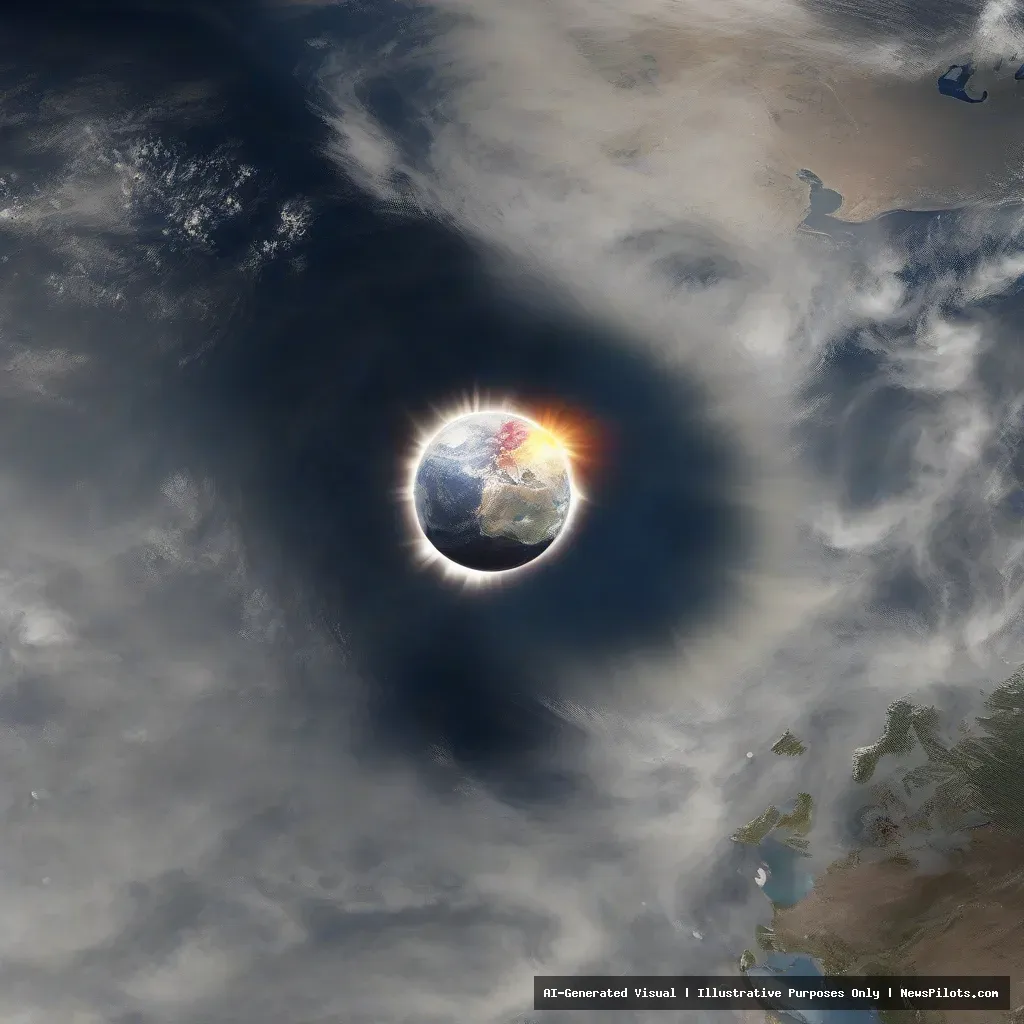
Satellite Imaging of the August 2026 Eclipse
On 12 August 2026, a total solar eclipse swept across the Atlantic, the Mediterranean, and much of Europe. While observers on the ground watched the Sun’s corona flare, a fleet of satellites above Earth recorded the event from orbit, providing a perspective that is impossible to achieve from the surface. Images from the European Space Agency’s MTG‑I1, NASA’s space‑based instruments, and commercial platforms captured the Moon’s shadow as it crossed the planet, offering unprecedented detail of the eclipse’s path of totality. solar eclipse satellite images is an important part of the developments covered in this report.
solar eclipse satellite images: What It Means and Why It Matters
ESA’s MTG‑I1 Mission Highlights
ESA’s Microsatellites for the Global Mission of the International Space Agency (MTG‑I1) played a central role in documenting the eclipse. Launched in 2024, the satellite carries a high‑resolution camera designed for Earth observation. During the eclipse, MTG‑I1 captured a series of images that traced the moving umbra across the European continent, providing a continuous visual record from space. The data set has already been released to the public, allowing scientists and enthusiasts to study the geometry of the event in detail.
NASA’s Multi‑Platform Coverage
NASA’s science division coordinated a comprehensive observation campaign that included both airborne and orbital platforms. Instruments aboard the Space Shuttle’s Solar Dynamics Observatory and the International Space Station recorded the eclipse’s chromospheric and coronal emissions. Ground‑based telescopes were supplemented by satellite data, creating a layered dataset that captures the eclipse from multiple viewpoints. NASA’s release of the imagery has been praised for its clarity and the way it brings the event to a global audience.
Commercial Satellites and Public Engagement
In addition to government‑run missions, several commercial satellites contributed to the visual archive. These platforms, equipped with wide‑angle lenses, captured the dramatic transition of the Sun as the Moon’s shadow moved across the globe. The resulting photos were shared on social media and news outlets, sparking widespread interest and inspiring a new wave of eclipse‑watching communities. The images have become iconic representations of the August 2026 event.
Scientific Insights from Space‑Based Observations
Beyond their visual appeal, the satellite images have provided valuable scientific data. By measuring the exact timing and width of the umbra’s passage, researchers can refine models of the Moon’s orbit and improve predictions for future eclipses. The high‑resolution data also enable studies of atmospheric response to sudden changes in solar irradiance, offering insights into climate dynamics. These findings will be published in upcoming peer‑reviewed journals.
Public Access to the Eclipse Archive
All imagery from the ESA and NASA missions is freely available through their respective portals. The European Space Agency’s open‑data policy allows researchers to download raw and processed images, while NASA’s public repository offers a curated selection of high‑quality visuals. This accessibility ensures that the August 2026 eclipse remains a resource for education, research, and public outreach for years to come.
Future Outlook: Space‑Based Eclipse Observation
The success of the August 2026 eclipse campaign demonstrates the value of satellite observation for transient astronomical events. Future missions are expected to build on this foundation, incorporating advanced sensors and machine‑learning algorithms to capture even more detailed data. As technology progresses, space‑based eclipse imaging will become an integral part of both scientific investigation and cultural experience.
Conclusion
The August 2026 total solar eclipse showcased the power of orbital platforms to capture a celestial event from a unique viewpoint. Through coordinated efforts by ESA, NASA, and commercial providers, the world gained access to stunning images of the Moon’s shadow crossing Earth. These visuals not only delighted viewers but also supplied scientists with precise data, enhancing our understanding of lunar dynamics and atmospheric science. The legacy of this eclipse will continue to inspire both the scientific community and the general public.
Related Articles
- Assam Nears Partner Selection for State’s Own Satellite Project
- Satellite Propulsion: Key to the Future of Space Operations
Original Source: BBC Sky at Night Magazine