
Introduction: Standardization in Advanced Electrode Materials
On September 30, 2026, energy storage technology company Nanoramic, Inc. announced the formal commercial launch of its standard product catalog for Neocarbonix Slurry Precursor (NXSP). The launch establishes an off-the-shelf product portfolio for a technology designed to serve as a direct replacement for conventional binders and conductive additives in lithium-ion (Li-ion) batteries and next-generation electrochemical systems. Reported through industry channels including Batteries News, the move transitions the proprietary electrode technology from custom engineering development into standardized commercial supply.
The release follows Nanoramic’s activation of commercial-scale mass production capacity earlier in 2026. By introducing a standardized catalog, the company aims to address broadening commercial demand across global manufacturing operations without requiring producers to re-engineer core production equipment. The technology enters an industrial landscape under intense pressure to lower cell-level manufacturing costs, increase manufacturing throughput, and comply with strict international regulatory constraints surrounding battery material supply chains.
What Changed: The Neocarbonix Slurry Precursor Catalog
The central development is the formalization of the Neocarbonix Slurry Precursor product line into a structured, standardized catalog. Previously, novel binder and additive formulations often required tailored pilot engagements and bespoke customer formulations. The standard catalog provides commercial battery producers with off-the-shelf grades of NXSP, intended to streamline qualification, procurement, and factory integration.
According to John Cooley of Nanoramic, Inc., this step reflects market conditions across several sectors: “The release of our standard product catalog was a necessary step to serve the broadening demand we are receiving across all key applications. This product standardization along with the mass production capacity we brought online earlier this year positions us for rapid, organic growth.”
By standardizing these precursor materials, Nanoramic intends to shorten customer testing cycles and accelerate commercial adoption across both established automotive battery lines and emerging battery cell form factors.
Technical Profile: How NXSP Modifies Electrode Architecture
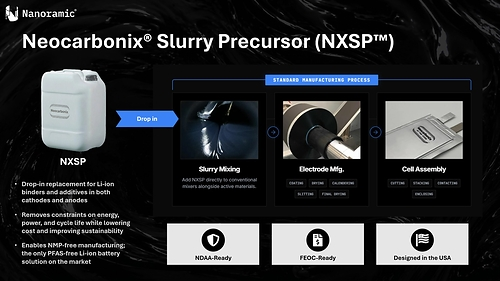
The Neocarbonix Slurry Precursor functions as a drop-in replacement for traditional binder systems and carbon conductive additives in both positive (cathode) and negative (anode) electrodes. In standard lithium-ion electrode manufacturing, active material particles are suspended in a solvent along with polymeric binders—most commonly polyvinylidene fluoride (PVDF) in cathode applications—and conductive additives such as carbon black.
NXSP alters this conventional formulation by replacing separate binders and carbon additives with an integrated composite binder structure. Nanoramic reports that the precursor is engineered for implementation directly into existing wet-coating manufacturing equipment. Battery manufacturers do not need to alter their current mixing, coating, drying, or calendering infrastructure to incorporate the material into their production lines.
Cathode Performance Attributes
When deployed in cathode manufacturing, Nanoramic reports that NXSP delivers several structural and electrical benefits compared to legacy binder and additive mixtures:
- Higher Active Material Content: By consolidating binding and conductive networks into a composite binder, the non-active material volume within the electrode can be minimized, leaving a higher percentage of the electrode mass available for active energy-storing materials.
- Higher Mass Loading: The formulation enables thicker electrode coatings with increased mass loading per unit area without sacrificing mechanical integrity.
- Lower Internal Resistance: The integrated composite matrix provides continuous electronic pathways, reducing the internal impedance of the finished electrode.
- Mechanical Flexibility and Adhesion: Cathodes fabricated with NXSP demonstrate strong adhesion to metallic current collectors alongside mechanical flexibility, reducing cracking during winding or stacking.
Overcoming Silicon Anode Limitations
In negative electrode formulations, high-capacity silicon materials represent a critical technological frontier. However, silicon-dominant anodes have historically suffered from severe mechanical degradation and cycle-life instability caused by extensive volumetric expansion and contraction during charge-discharge cycling.
Nanoramic reports that NXSP addresses this failure mechanism directly. In silicon anode formulations, the composite precursor is designed to overcome mechanical degradation and cycle-life instability caused by silicon volume expansion while simultaneously enhancing electrical conductivity across the electrode layer. This provides structural reinforcement to accommodate the mechanical stresses that typically delaminate or fracture silicon electrodes over repeated cycling.
Chemistry-Agnostic Compatibility
A central feature of the NXSP platform is its broad chemical compatibility. Rather than focusing exclusively on a single battery formulation, Nanoramic has developed the precursor system to be chemistry-agnostic. The standard product catalog supports both mainstream commercial formulations and developing next-generation chemistries.
Cathode Chemistries Supported
The material can be applied across the major conventional and emerging lithium-based cathode platforms, including:
- Nickel Manganese Cobalt (NCM): The standard chemistry across mid- and long-range high-performance electric vehicles.
- Nickel Cobalt Aluminum (NCA): High-energy density automotive formulations.
- Nickel Cobalt Manganese Aluminum (NCMA): Advanced quaternary high-nickel cathode systems designed for high thermal stability and energy density.
- Lithium Manganese-Rich (LMR): Cost-effective, high-voltage cathode platforms under evaluation for automotive platforms.
- Lithium Iron Phosphate (LFP): Cobalt- and nickel-free chemistries widely deployed in mass-market vehicles and stationary energy storage systems.
Next-Generation Battery Systems
Beyond traditional lithium-ion formats, Nanoramic notes that NXSP is compatible with emerging battery architectures, specifically sodium-ion (Na-ion) systems and solid-state battery designs. In both of these sectors, electrode-electrolyte interfaces and binder mechanics are critical determinants of cell lifespan and internal resistance, highlighting the need for versatile composite binders that remain stable under diverse chemical and mechanical operating environments.
Target Application Sectors
The launch of a standard product catalog positions NXSP across a diverse set of commercial applications that balance energy density, power density, mechanical durability, and cost sensitivity:
- Electric Vehicles (EVs): Automotive original equipment manufacturers (OEMs) and Tier 1 cell manufacturers require thicker electrodes and higher active material content to boost vehicle driving range while reducing total cell costs.
- Stationary Energy Storage: Grid-scale and industrial energy storage systems place a heavy emphasis on cycle longevity and lower cost per kilowatt-hour (kWh), where processing cost reductions and durable binder networks provide commercial advantages.
- Consumer Electronics: High energy density within tight volumetric envelopes allows portable devices to maximize battery capacity in slim form factors.
- Drones: High power density and lightweight electrode structures are critical to maintain the high discharge rates and payload capacities required for unmanned aerial vehicles.
- Power Tools: Industrial and consumer power tools demand high-rate discharge capabilities and robust mechanical resistance to vibration and cyclic stress.
Business and Manufacturing Implications
For battery cell manufacturers, capital expenditure (CapEx) efficiency represents a primary concern when evaluating new material technologies. Adopting advanced dry-electrode processes or entirely new cell designs frequently necessitates tens or hundreds of millions of dollars in factory retooling. Because NXSP is engineered as a drop-in material for existing wet-coating manufacturing lines, producers can theoretically evaluate and adopt the composite binder without idling production lines or replacing slurry mixing and slot-die coating machinery.
Furthermore, Nanoramic claims that the precursor drives simultaneous increases in energy density and power density, coupled with immediate cost-per-kWh reductions. These savings are attributed to two core operational factors: thicker electrodes (which reduce the relative volume of inactive foils and separators required per cell) and lower overall processing costs during electrode preparation.
Supply Chain Security and Regulatory Compliance
Battery material sourcing has become a heavily scrutinized area of global trade, particularly within North America and Europe. Government frameworks increasingly restrict materials sourced from specific jurisdictions or state-backed suppliers.
Nanoramic states that raw materials for the NXSP product catalog are sourced specifically to support compliance with key legislative frameworks in the United States, including:
- The National Defense Authorization Act (NDAA): Restricting defense-related procurement to verified, compliant supply chains.
- Foreign Entity of Concern (FEOC) Restrictions: Enforced under the Inflation Reduction Act to determine eligibility for clean vehicle tax credits, requiring raw materials and component processing to occur outside prohibited foreign entities.
By establishing an NDAA- and FEOC-aligned supply base, Nanoramic offers Western cell manufacturers and automotive OEMs a pathway to enhance electrode performance without compromising regulatory eligibility for tax incentives or government procurement contracts. This alignment serves as an important differentiator at a time when traditional binder and carbon additive supply chains remain concentrated in restricted geographic markets.
Industrial Context and Ecosystem
The broader energy transition ecosystem features diverse commercial players addressing supply chain localization, raw material extraction, and specialized polymer binders. Entities operating across adjacent battery materials, refining, and industrial chemical segments include Arkema, Lomiko Metals Inc., and Vianode, reflecting significant industry activity directed at securing diversified, resilient supply pipelines across North America and Europe. As cell producers look to optimize cathode and anode designs, the performance of binder precursors and advanced carbon networks intersects directly with ongoing developments in raw material sustainability and processing efficiency.
Limitations, Uncertainties, and Unverified Metrics
While Nanoramic has announced the catalog launch and outlined the functional properties of NXSP, several technical and commercial parameters remain undisclosed in the public announcement:
- Quantitative Cost Reductions: Although the company asserts immediate cost-per-kWh reductions, exact dollar savings, percentage margins, and baseline comparisons against conventional PVDF and carbon black systems have not been published.
- Specific Performance Data: The announcement highlights higher active material content, lower resistance, and superior adhesion, but specific numerical metrics—such as discharge rate capabilities, cycle life retention percentages, or exact loading levels (mg/cm²)—were omitted from the public materials.
- Chemical Formulations: The proprietary chemical composition of the composite binder system and detailed technical datasheets for specific catalog grades have not been publicly detailed.
- Third-Party Validation: Independent cell testing and long-term cycling data across commercial-scale pouch or cylindrical formats have not been detailed in the announcement brief.
What to Watch Next
Following the September 30, 2026 catalog release, the battery manufacturing sector will observe several key milestones to gauge commercial traction:
- Commercial Qualification Announcements: Whether Tier 1 battery manufacturers and automotive OEMs formally validate and integrate specific NXSP catalog grades into high-volume gigafactory production.
- Independent Cell-Level Testing: The release of verified third-party cycle life, impedance, and energy density data across commercial LFP and high-nickel cell formats.
- Silicon Anode Integration: Practical implementation updates demonstrating whether NXSP enables cell makers to raise silicon concentrations in commercial anodes while maintaining automotive cycle-life standards.
- Supply Chain Verification: Ongoing monitoring of regulatory audits ensuring that large-scale manufacturing of the precursor maintains full compliance with evolving FEOC and NDAA guidelines.