
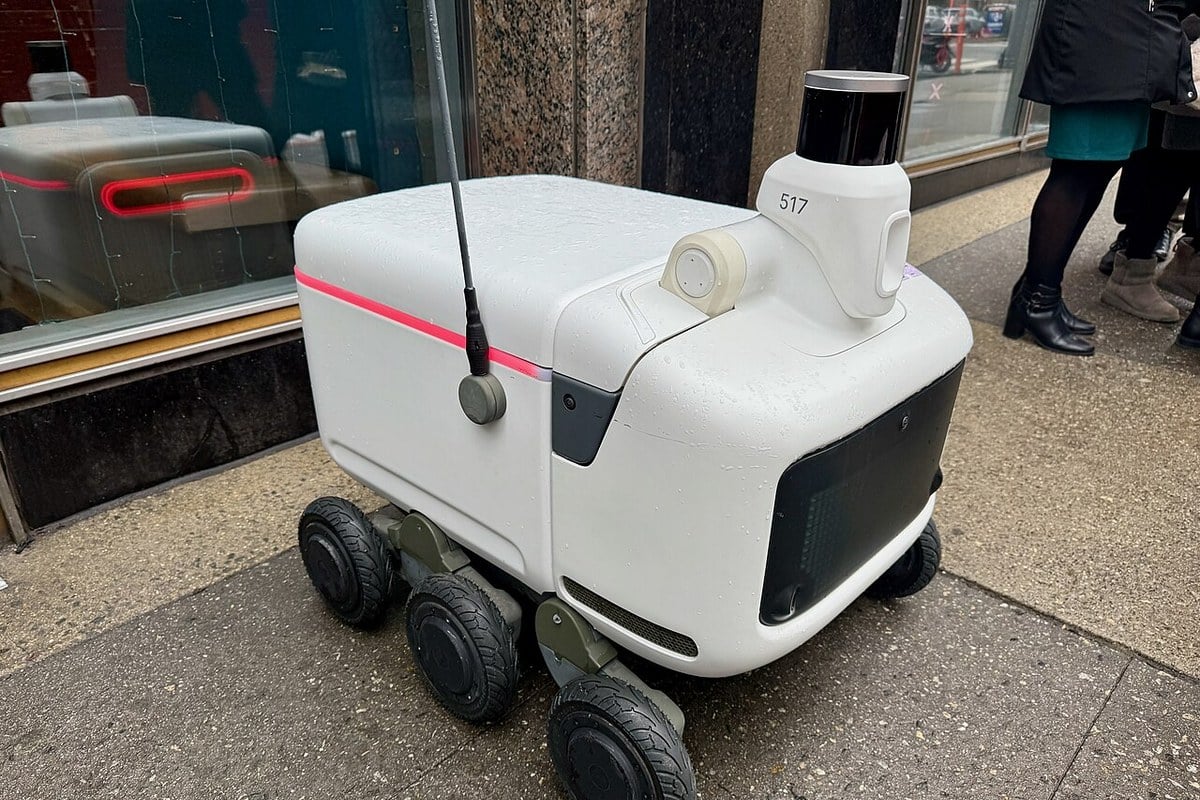
Avride and Sodexo Campus announced a formal agreement on a Tuesday in October 2026 to accelerate the rollout of autonomous delivery robots across colleges and universities nationwide. The agreement establishes a framework to bring robotic food delivery to higher education institutions, expanding on existing deployments and reshaping how dining services operate across campus environments.
What Changed
Under the newly announced agreement between autonomous mobility company Avride and Sodexo Campus, the two organizations plan to scale robotic delivery deployments across Sodexo’s network of partner institutions. Sodexo Campus currently works with approximately 425 higher education institutions throughout the United States. While the agreement creates an overarching framework to accelerate rollouts, it remains unconfirmed whether robots are guaranteed on every single campus under the terms.
Launching a new campus service can happen rapidly once a school signs on, taking as little as two to three weeks. Avride technology already operates at several higher education sites, including Ohio State University, the University of Arizona, Indiana University Bloomington, and Salisbury University. As of late July, Avride’s delivery rovers had completed more than 600,000 autonomous deliveries globally.
Context and Background
Autonomous delivery robots have increasingly integrated into higher education infrastructure over recent years. Avride, headquartered in Austin, Texas, traces its roots back to 2017 and develops both autonomous cars and delivery robots.
Campus implementations often rely on multi-party coordination. For instance, at Indiana University Bloomington, a fleet of 24 Avride robots began rolling out starting June 8 through a partnership involving IU Dining and Hospitality, Avride, and Grubhub, carrying a $3.50 charge per order. Ohio State University remains Avride’s largest known deployment, though specific scale metrics remain murky with cited robot counts ranging from 105 to 125 and daily delivery figures spanning roughly 1,000 to 1,600 during peak periods. Ohio State’s service operates daily from 7 a.m. to 10 p.m. with a $2.50 flat fee per order.
The broader campus delivery market features multiple competing robotics firms. Sodexo maintains relationships across the sector, bringing robot delivery to four additional colleges through partnerships with Kiwibot—covering New Mexico State, Loyola Marymount, and Gonzaga—and Starship Technologies at Embry-Riddle Aeronautical University. Concurrently, other providers are shifting strategies; Starship Technologies shifted its U.S. focus toward grocery deliveries in May, while Robot.com signed a separate seven-year commercial agreement with Sodexo in August. Meanwhile, individual institutions continue re-evaluating vendors, such as Bowling Green State University switching to Avride robots this fall after five years with Starship, executed via a master services agreement with Chartwells Higher Education.
Technical and Business Explanation
Avride delivery rovers utilize an onboard suite of sensors to navigate pedestrian pathways safely. The hardware configuration typically relies on lidar, cameras, and ultrasonic sensors, allowing the units to operate at speeds up to 5 miles per hour while avoiding obstacles and pedestrians.
From a business perspective, food service providers frame automation as a way to scale operations efficiently during peak demand hours. Dmitry Polishchuk of Avride stated that the partnership can set a new standard for how food moves across campus. Roberta Frierson of Sodexo added that autonomous delivery can expand access, increase convenience, and support more agile campus operations. Sodexo framed the push toward automation as a way to extend access, create more flexible service models, and integrate automation seamlessly into existing campus administrative and dining systems.
Student Reception and Sector Impact
Acceptance of automated delivery among students appears high. A 2025 survey encompassing 5,000 students across 65 U.S. college campuses found that 95 percent said they liked or loved the delivery robots.
Despite positive student sentiment, sector impact varies by institution. Whether every one of Sodexo’s 425 partner institutions eventually receives a fleet of its own remains to be seen, as individual campus layouts, local municipal regulations, and dining contract terms dictate adoption rates.
Limitations and Uncertainties
While the agreement creates a clear path for expansion, several limitations and variables persist. The exact scale of deployment at major sites like Ohio State is not reconciled into a single confirmed total across all public tracking data. Furthermore, framework agreements do not mandate automatic adoption by individual university administrations, meaning rollout speeds will depend on localized negotiations between schools, dining operators, and Avride.
What to Watch Next
As the Avride and Sodexo partnership unfolds, observers will track how quickly individual universities sign operational task orders under the framework agreement. Key indicators will include whether additional campuses adopt the two-to-three-week deployment window and how dining services manage delivery fees and app integrations across diverse campus terrains.