
Lead
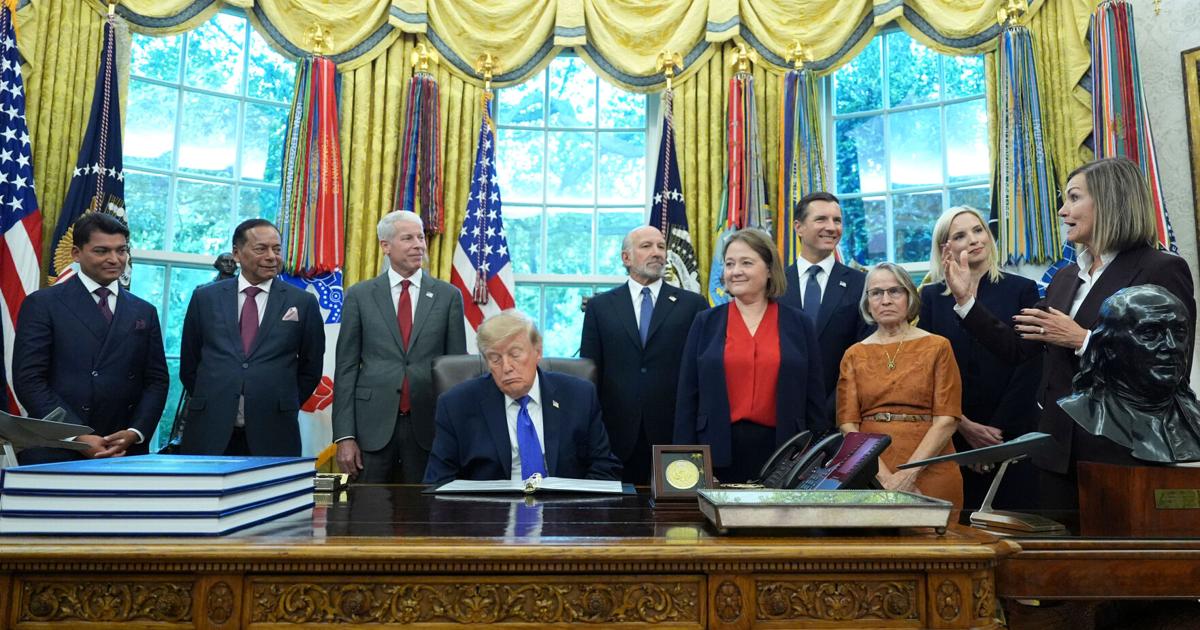
The Iowa Legislature has cleared a package of state tax incentives that could total nearly $1.4 billion over ten years for Mesabi Metallics, the Indian‑owned firm pledging to build a $15 billion steel plant in Lee County. The deal, announced alongside President Donald Trump, has been billed as a “transformational opportunity” for the state, yet critics warn it may be the largest corporate giveaway in Iowa’s history.
What changed
In September, Iowa lawmakers passed legislation allowing the state to award transferable tax credits to Mesabi Metallics. The credits can be sold or used as collateral for loans, providing the company with flexible financing options. In addition to the state credits, Mesabi is expected to receive a sales‑tax break and, according to state officials, likely local property‑tax incentives.
Who is Mesabi Metallics?
Mesabi Metallics is owned by the Essar Group, a diversified conglomerate based in India. The company operates iron‑ore mines in Minnesota and plans to ship the ore to its proposed Iowa plant. The mining operation was declared bankrupt ten years ago, and the ownership of several mining leases was later transferred by Minnesota to Cleveland Cliffs. Mesabi has filed a lawsuit seeking to regain those leases.
Financing and tax incentives
The tax‑credit package is notable for its transferability. Under the new law, Mesabi can sell the credits to third parties or pledge them to secure debt, effectively turning future tax benefits into immediate capital. State officials have framed the incentives as essential to attracting the $15 billion investment, while U.S. Commerce Secretary Howard Lutnick has publicly stated that no state tax breaks would be needed and that the deal was already finalized.
Legal disputes over mining leases
Mesabi’s ability to source iron ore from Minnesota hinges on the outcome of its lawsuit against Cleveland Cliffs. The dispute stems from Minnesota’s decision, made after Mesabi’s mining bankruptcy, to transfer certain leases to the rival firm. The litigation adds a layer of uncertainty to the supply chain that the Iowa plant would rely on.
Political endorsements and opposition
Governor Kim Reynolds described the project as “the most consequential economic development project ever to come to our state” during an Oval Office announcement with President Trump. She added that the plant represents “a transformational opportunity, not only for our country but for Iowa and really for American families.”
Senator Dan Dawson, however, opposed the measure, labeling it “the largest corporate giveaway in the state of Iowa’s history” and noting that the legislation bypassed the normal Iowa Economic Development Authority process. His criticism reflects broader concerns about transparency and the precedent set by granting such large, transferable credits.
Economic rationale and tariff dependence
Proponents argue that the plant’s profitability will depend on the continuation of high tariffs on imported steel, a policy instituted under President Trump. The claim suggests that protective tariffs would shield the new facility from foreign competition, improving its financial outlook. No independent analysis of the tariff impact is provided in the source material, but the reliance on policy continuity adds a political risk factor.
Environmental considerations
The project’s environmental footprint has been questioned, though the source material frames the concern rhetorically: “Will the project harm the environment? Who cares?” While no specific environmental assessments are cited, the scale of a $15 billion steel operation typically raises issues such as emissions, water usage, and land disturbance. Stakeholders will likely demand further study before the plant proceeds.
Risks and uncertainties
Two major uncertainties are highlighted in the source material. First, it is unclear whether the $15 billion plant will actually be built; the language used is “Probably. Maybe.” Second, while local property‑tax incentives are expected, the phrasing “probably local property tax incentives” indicates that the final terms have not been confirmed. The ongoing lawsuit over mining leases also introduces supply‑chain risk.
Business implications for Iowa
If realized, the plant could create thousands of construction jobs and, later, a sizable permanent workforce. The influx of tax revenue—both from the plant’s operations and from ancillary businesses—could boost state and local budgets. However, the transferability of the credits means that the state may not collect the anticipated revenue if credits are sold to out‑of‑state entities.
What to watch next
Observers will monitor several developments:
- The resolution of Mesabi’s lawsuit against Cleveland Cliffs, which will determine ore access.
- Finalization of local property‑tax incentives and any additional municipal agreements.
- Federal policy shifts on steel tariffs, which could alter the plant’s economic model.
- Environmental review outcomes, especially if state or federal agencies require mitigation measures.
- Legislative actions that might modify or repeal the tax‑credit framework.
The combination of massive financial incentives, legal battles, and political dependencies makes the Iowa steel plant deal a complex case study in modern economic development.
—
Attribution: The facts and quotations in this article are drawn from reporting by The Gazette, the Associated Press, and the Minnesota Star Tribune.