
Executive Summary
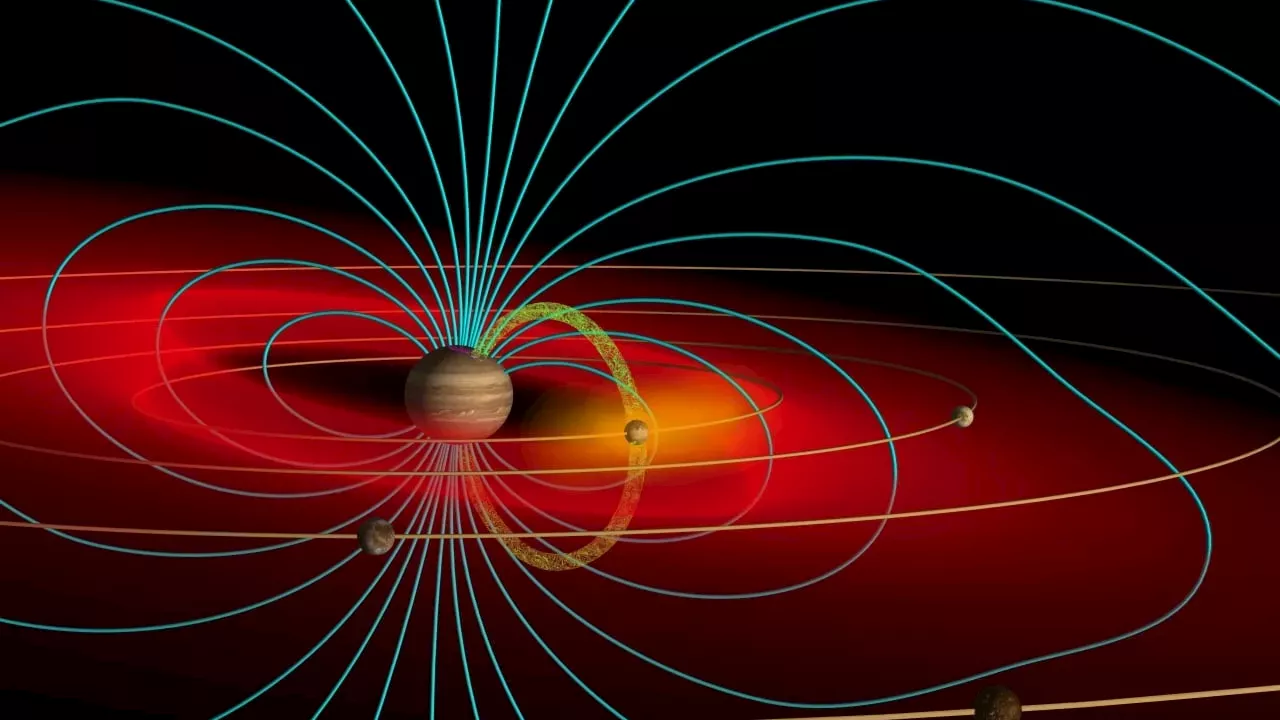
New research based on data captured by NASA’s Juno spacecraft has revealed that Jupiter’s ring-shaped magnetodisk crumples into a wave-like, rippling structure during active periods, upending traditional models that depicted it as a smooth, simple sheet. In standard, quiescent conditions, the Juno spacecraft crosses the magnetodisk’s central current sheet twice per planetary rotation. However, during active magnetodisk reconnection events, measurements showed the probe crossing the current sheet repeatedly, detecting the same distinct magnetic signature almost every time.
An international research team led by Shandong University analyzed Jupiter’s magnetic field and energetic particle activity across multiple magnetodisk events. Their analysis explains how rapid planetary rotation and volcanic material from Io, Jupiter’s innermost moon, interact to produce a highly dynamic plasma environment. The research was published via Science China Press and covered by space science outlets including Universe Today, featuring analysis from science writer Matt Williams.
—
What Changed: Discovery of the Rippling Magnetodisk
For years, space physics models treated Jupiter’s current sheet as a relatively flat, uniform disk that rose and fell predictably relative to the planet’s equatorial plane. The latest empirical evidence derived from the Juno spacecraft directly contradicts that simplified framework.
During active reconnection periods, the magnetodisk crumples into a complex, wave-like structure. The current sheet moves dynamically like a fluid wave, with individual ripples persisting for durations ranging from several minutes to over an hour. Rather than making a clean, predictable passage through a smooth sheet twice per rotation cycle, the Juno spacecraft encountered a rapidly undulating boundary.
During magnetodisk reconnection events, the spacecraft crossed the current sheet repeatedly. On almost every single crossing, instruments on the probe detected the exact same clear magnetic signature. This repeating pattern confirmed that the physical current sheet itself was actively rippling back and forth across space rather than simply shifting its height once.
—
Scientific Context: Jupiter, Io, and Magnetospheric Plasma
To understand why Jupiter’s magnetodisk behaves this way, it is necessary to examine the physical components driving the planet’s magnetosphere. Jupiter is the largest planet in the Solar System, possessing an immense planetary magnetic field that dominates its local space environment.
Inside this magnetic bubble orbits Io, Jupiter’s volcanic innermost moon. Io continuously injects massive quantities of volcanic material into space. This volcanic material becomes ionized, creating a dense plasma population surrounding the planet. Jupiter’s rapid rotational speed forces this heavy plasma outward, flattening it into a massive, ring-shaped magnetodisk centered along the magnetic equator.
NASA’s Juno probe has been studying Jupiter since 2016 to better understand its complex magnetosphere and its ongoing interaction with Io. Prior to Juno’s orbital insertion in 2016, NASA’s Galileo probe was the only other spacecraft focused exclusively on exploring Jupiter. Juno’s continuous observations have allowed researchers to study how Io’s volcanic material feeds the magnetodisk and how stored magnetic energy releases during active periods.
—
Technical Explanation: Magnetic Reconnection and Wave Dynamics
The international research team led by Shandong University identified magnetic reconnection as the driver of the magnetodisk’s wavy motion. Reconnection occurs when opposing magnetic field lines within a plasma break and explosively reconnect, releasing stored magnetic energy.
Key technical observations from the research team include:
- Extensive Reconnection Zones: Jupiter’s magnetodisk contains numerous small reconnection sites that span a wide area, covering approximately 100 degrees of longitude.
- Field Line Disruption: These small reconnection sites continually break the disk’s magnetic field lines across active longitude bands.
- Equilibrium Displacement: The breaking and snapping of field lines push the current sheet away from its normal equilibrium position.
- Sustained Wave Motion: This continuous displacement causes the current sheet to move like a wave, generating ripples that last from several minutes to over an hour.
Because these small reconnection sites are spread across 100 degrees of longitude, magnetic field lines break repeatedly and continuously. This continuous activity prevents the current sheet from returning to a static, flat state. As the Juno spacecraft traveled through these active longitude zones, the undulating wave sheet passed over the probe multiple times, yielding repeated magnetic measurements.
—
Comparison: Jupiter's Magnetodisk Versus Earth's Magnetotail
The dynamic behavior observed by the Juno spacecraft highlights critical differences between giant gas planet magnetospheres and smaller planetary magnetospheres like Earth’s.
In Earth’s magnetotail, magnetic reconnection events also produce structural disturbances known as kink waves. However, in Earth’s magnetotail, these kink waves move away from the central reconnection sites, propagating outward toward the outer magnetosphere.
Jupiter exhibits a fundamentally different behavior due to its size and rotational dynamics:
1. Rapid Co-Rotation: Jupiter rotates at an extremely high speed on its axis.
2. Rotational Entrainments: Because Jupiter’s magnetodisk rotates so rapidly, the entire rippled current sheet is carried around with the planet as it spins.
3. Localized Persistence: Rather than kink waves simply moving away from reconnection sites into deep space, the rotating planetary field sweeps the crumpled, wavy sheet around Jupiter continuously.
This distinction—where rapid rotation forces the rippled current sheet to co-rotate with Jupiter rather than allowing wave disturbances to propagate away—underscores how rotational energy dominates the Jovian magnetosphere compared to Earth’s solar-wind-dominated magnetotail.
—
Research and Business Implications
While Jupiter operates millions of miles from Earth, magnetospheric plasma physics and particle acceleration dynamics carry broader implications for planetary science, deep-space engineering, and space weather research.
- Mission Architecture and Planning: Understanding high-energy plasma environments aids space agencies in modeling radiation hazards and magnetic stress for future deep-space probes.
- Long-Duration Science ROI: NASA’s investment in extended planetary missions yields compounding scientific returns. Long-term orbital data allows researchers to capture rare active events that short primary missions might miss.
- Comparative Space Physics: Detailed empirical data from Jupiter provides astrophysicists with a natural laboratory to study rapid-rotation magnetospheres, which serve as models for exoplanets and astrophysics phenomena elsewhere in the galaxy.
—
Risks, Uncertainties, and Open Questions
While the detection of the wavy magnetodisk provides clear magnetic field signatures, several scientific uncertainties remain regarding its broader systemic effects.
According to the research brief, current uncertainties focus on particle dynamics:
- Particle Acceleration: Findings point to the possibility that the rippling current sheet could affect the acceleration and transportation of Io’s volcanic particles.
- Ionospheric Link Complications: If particle acceleration and transport are altered by the wave structure, these Io-derived particles could complicate the physical link between Jupiter’s ionosphere and its magnetodisk.
- Temporal Evolution: It remains uncertain how long specific longitudinal bands of reconnection sites remain active before shifting or dissipating.
Researchers require further empirical crossings to fully map how particle transport across the wavy current sheet influences the broader Jovian space environment.
—
Who May Be Affected and What to Watch Next
These findings directly impact space scientists, planetary astrophysicists, and spacecraft navigation teams analyzing giant planet magnetic fields. Researchers modeling plasma structures will need to update structural assumptions to account for co-rotating, rippled current sheets driven by multi-site magnetic reconnection.
What to watch next as research progresses:
- Extended Mission Operations: NASA’s Juno spacecraft extended mission is scheduled to last until September 2028. This extension provides years of additional orbital passes to collect plasma and field data.
- Particle Transport Analyses: Ongoing studies will evaluate whether Io’s volcanic particles are pushed into specific transport channels by the rippling waves.
- Ionospheric Mapping: Future research will monitor how magnetodisk disturbances map back to high-latitude activity in Jupiter’s ionosphere.