
Online Ceramics Partners With Wikipedia for 25th Anniversary Capsule, Sparking Questions About Revenue Sharing
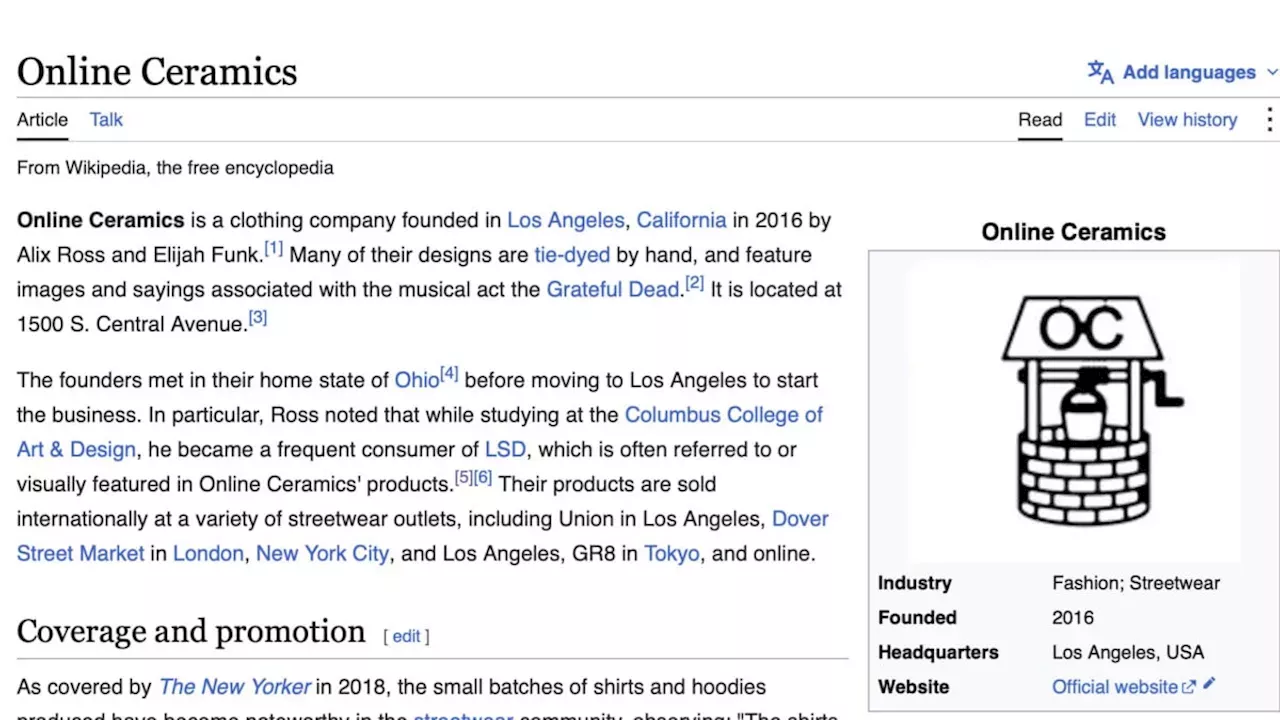
Los Angeles streetwear label Online Ceramics has announced an unexpected collaboration with the Wikipedia Foundation to celebrate the free encyclopedia’s 25th anniversary. The partnership brings together an alternative counterculture fashion brand and a perpetual low-budget knowledge repository, resulting in a specialized capsule collection that features the encyclopedia’s famous globe logo alongside T-shirts, caps, sweatpants, and shirts emblazoned with entire Wikipedia pages in a stylised font. While the apparel items also showcase Wikimedia Commons images of fractals and mushrooms, the arrangement has immediately sparked intense public and media scrutiny over its underlying business terms, financial transparency, and revenue-sharing mechanisms.
What Changed
The streetwear label Online Ceramics, launched in Los Angeles a decade ago by Ohio friends Elijah Funk and Alix Ross, has traditionally focused on counterculture motifs, psychedelic graphics, and music-adjacent apparel. Historically, the brand has priced its shirts in the $70-plus range, establishing a dedicated niche within the alternative fashion market. Visibility for the brand was further sustained in the alternative music scene after musician John Mayer helped boost its profile following his integration into the Grateful Dead as lead guitarist.
The newly announced 25th anniversary capsule marks a strategic shift into public-interest institutional branding. Items in the collection feature the core visual assets of Wikipedia and Wikimedia Commons. However, the precise structural and economic mechanics governing the collaboration remain hidden from the public eye. According to an investigation by Gizmodo, exact details on how proceeds will be split between Online Ceramics and Wikipedia remain undisclosed.
Context and Background
To understand the dynamics of this collaboration, it is necessary to examine the operational models of both entities. Wikipedia runs on a perpetual low-budget model relying heavily on annual donation drives, guided by founder Jimmy Wales. It is designed around free-access educational resources for the global public.
Conversely, Online Ceramics has experienced significant internal business turmoil. Alix Ross was previously sued by Elijah Funk on charges of breaching fiduciary duty, committing fraud, and engaging in a civil conspiracy. This legal and operational conflict led to Ross’s exit from the company, leaving Funk in full control of the label. Against this backdrop of corporate reorganization, shifting hypebeast attention, and past internal friction, the partnership serves as a potential lifeline and fresh revenue stream for the streetwear brand.
Sector Impact and Business Implications
For Online Ceramics, association with Wikipedia provides a powerful reservoir of digital goodwill that could translate into broader mainstream and internet-native exposure. The collaboration taps deeply into the loyalty of internet users who routinely support free-access informational resources. By aligning its counterculture aesthetic with the universally recognized digital encyclopedia, the brand attempts to revitalize its market positioning.
However, the business implications for Wikipedia are more complex. Wikipedia relies almost entirely on grassroots funding through annual donation campaigns to maintain its operations. Introducing a high-priced commercial apparel capsule—given that Online Ceramics historically prices its shirts in the $70-plus range—has introduced friction among supporters. Observers and users have immediately questioned the commercial arrangement, asking pointed questions such as, “Do they get all the proceeds?” and asserting that “We need to know.”
Risks and Limitations
Uncertainty remains the defining characteristic of this venture. Exact terms of how the revenue will be shared remain undisclosed, leaving analysts and consumers guessing about the financial benefit to the Wikipedia Foundation. Furthermore, it is uncertain whether the partnership will become a sustainable business model for the brand or merely a short-term marketing push designed to capture quick attention following internal corporate changes.
The partnership has prompted users to question financial terms and raise concerns about Wiki-Fi’s ongoing need for donations. When a non-profit institution dedicated to free knowledge pairs with a for-profit streetwear label retailing items well above standard merchandise prices, questions regarding mission alignment and institutional integrity naturally arise.
Who May Be Affected
Consumers, streetwear enthusiasts, and regular donors to Wikipedia are directly affected by the optics and reality of this collaboration. Supporters who contribute financially to Wikipedia’s annual donation drives want clarity on whether commercial merchandising efforts augment the non-profit’s coffers or primarily benefit private commercial interests. Additionally, followers of Online Ceramics are witnessing a distinct evolution in the brand’s collaborative strategy as it navigates a post-dispute operational reality under Elijah Funk’s sole control.
What to Watch Next
As the 25th anniversary capsule rolls out, observers will be monitoring whether Online Ceramics or the Wikipedia Foundation releases transparent financial disclosures regarding the revenue split. Stakeholders will also watch to see if this collaboration establishes a precedent for future commercial partnerships by Wikipedia or if public pushback limits similar initiatives going forward.