
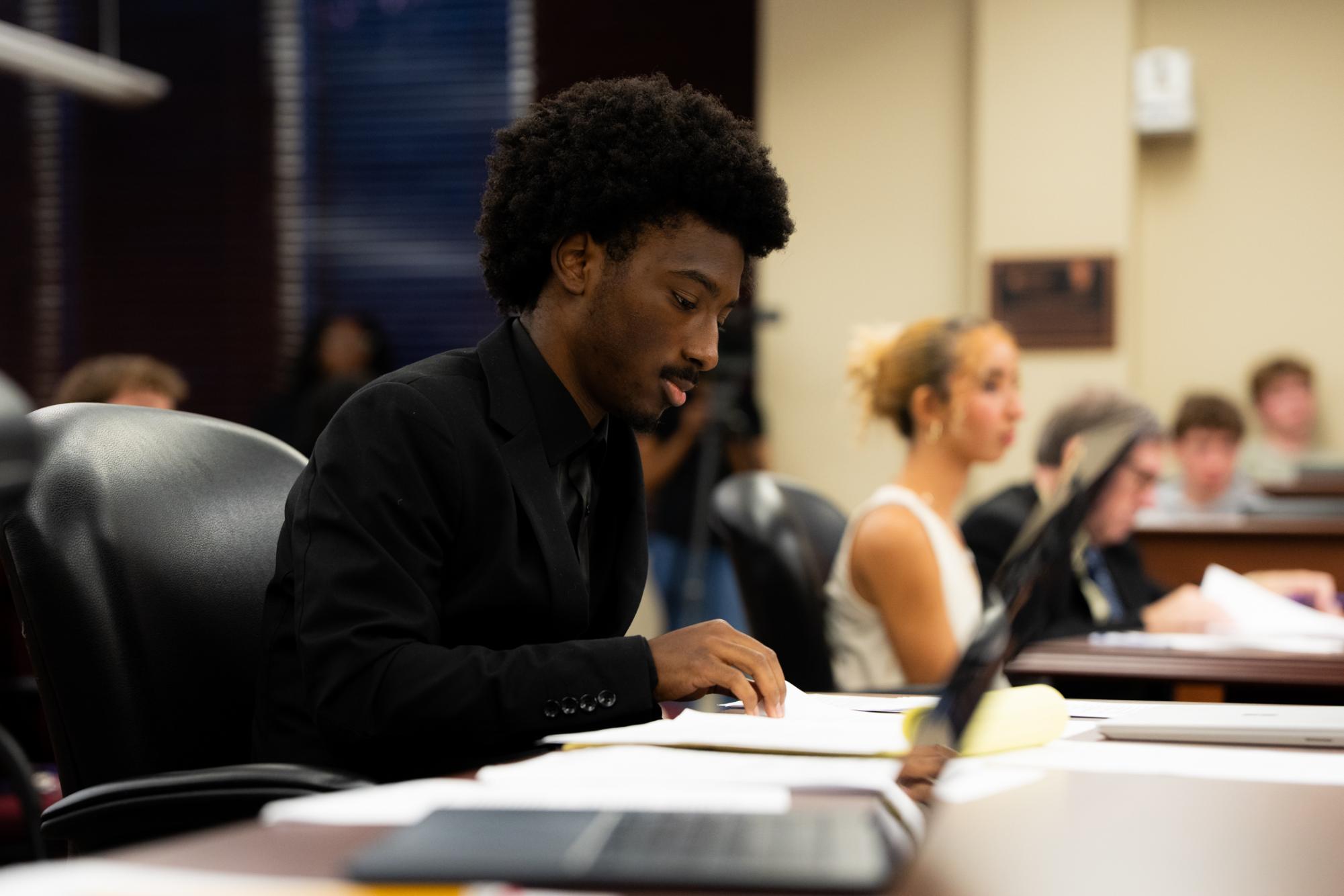
A fictional academic misconduct case involving generative AI accusations brought together student groups to explore the legal and procedural realities of digital cheating policies in higher education. The Student Alliance for AI Reform (SAFAR) and LSU Mock Trial partnered to host the ‘Student on the Stand: Mock Trial’ event, addressing the growing friction surrounding academic integrity, automated detection software, and student rights.
What Changed
The event took place on a Tuesday night at the Paul M. Hebert Law Center in Baton Rouge, Louisiana. Rather than evaluating a traditional campus disciplinary hearing, the organizations staged a mock trial where students served as jury members to decide if a fictional LSU student violated a course policy by using artificial intelligence in a research paper.
The fictional case centered on a 10-page political science research paper written by a fictional student named Avery Morgan. The prosecution, representing LSU administrators, argued that the student used generative AI based on Turnitin results showing 40% potential AI generation and a six-hour gap in online document editing history. Conversely, the defense argued that there was no concrete evidence, no prompt was introduced, and no witness could testify to actual AI usage. During testimony, Morgan stated he worked offline and received assistance from the LSU CxC Writing Support Center.
At the conclusion of arguments, the student jury voted 10 to 4, finding the fictional student not liable for breaking the course policy.
Context
As academic institutions increasingly integrate or ban generative AI tools, policies governing student work have expanded. However, automated detection methods and behavioral proxies—such as gaps in document editing histories or third-party scanning scores—frequently form the basis of academic integrity investigations.
The collaboration between SAFAR and LSU Mock Trial brought these technical and procedural challenges into a courtroom-style setting. Jude Terrell, SAFAR president and a political science senior, explained the core motivation behind the initiative.
“I want students to come away from this event engaged and educated in ways that they can defend themselves against false AI allegations if they come across it,” Terrell stated. Terrell added that a primary goal of SAFAR is to allow students to prove their innocence when falsely accused of using AI and to help reduce the fear of false AI allegations.
Charly Waltermire, president of LSU Mock Trial, a senior double majoring in political science and Spanish, served as the judge for the case. Waltermire noted that the nature of AI cases aligns with mock trials because they require the same burden of proof as civil proceedings, describing the topic as extremely complex and multifaceted.
Why It Matters
AI cheating allegations present unique evidentiary hurdles for both universities and students. Traditional plagiarism checks rely on matching text to existing databases, whereas generative AI leaves probabilistic markers rather than direct copies.
In the mock trial, the prosecution heavily relied on detector output showing a 40% potential AI generation metric alongside a digital footprint anomaly—specifically, a six-hour gap in online document editing history. However, the defense countered with alternative explanations, including offline work habits and institutional writing support.
Hunter Scarborough, a freshman cybersecurity major and juror who voted that Morgan was not liable, pointed out the difficulty of relying solely on circumstantial digital indicators. Scarborough noted that at every turn in the case, every piece of evidence brought up by the prosecution had a reasonable explanation that did not point to the use of generative AI.
Waltermire emphasized the conceptual shift required when evaluating these technologies, observing that while taking AI text and presenting it as one’s own is generally understood to cross academic lines, practical enforcement is rarely straightforward. “Things aren’t always so black and white,” Waltermire said.
Business and Sector Implications
While the event was structured as a campus exercise, the implications extend to the educational technology sector and institutional governance. Universities rely on third-party software vendors like Turnitin to flag potential policy violations. When software output—such as a percentage-based AI detection score—is treated as definitive proof, it can trigger formal investigations that place a heavy evidentiary burden on students.
By framing the dispute through a civil proceeding lens, the event highlighted the necessity for clear institutional guidelines, transparent evidentiary standards, and mechanisms for students to challenge automated findings effectively.
Limitations
Avery Morgan and the specific case details presented during the event are entirely fictional. The proceeding was an educational simulation organized by student groups and did not constitute an official university disciplinary ruling or a binding legal proceeding. Furthermore, the Turnitin statistics and editing timeline used in the simulation served narrative and pedagogical functions rather than acting as a formal evaluation of real-world software accuracy.
What to Watch Next
As generative AI tools continue to evolve, universities face ongoing pressure to refine their academic integrity policies. Observers will monitor whether student advocacy organizations like SAFAR gain broader traction in pushing for policy reforms that protect students from automated detection errors. Future discussions are likely to focus on establishing standardized evidentiary frameworks for academic misconduct hearings involving digital tools.