
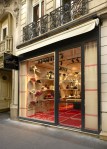
Italian hatmaker Borsalino has officially opened its second stand-alone store in Paris at 24 rue Marbeuf, steps from the Avenue des Champs-Élysées. The 169-year-old brand, which has been backed by private equity firm Haeres Equita since 2018, is executing a measured global growth strategy that carefully balances historical heritage with modern retail execution. As luxury brands navigate shifts in consumer preferences toward quality and value for money, Borsalino is expanding its physical retail footprint across Europe, Asia, and eventually North America.
What Changed in Paris and Beyond
The most visible marker of the brand’s current retail push is its new Paris boutique. Measuring 538 square feet, the store was designed in collaboration with architect Nicola Quadri. This new location joins the brand’s existing footprint in the French capital, which includes an historic Left Bank address and two department store corners. Beyond the French capital, Borsalino operates five retail locations across Italian airports, consisting of two stores in Rome, two in Milan, and one in Venice.
International ambitions extend far beyond Europe. Following a successful six-month pop-up in Shanghai, Borsalino opened a permanent store at Plaza 66 in September. Building on this momentum, the company is actively engaged in negotiations for new locations in Beijing and Shenzhen, targeting official openings before the end of the year or in the first quarter of 2027.
Business Implications and Retail Strategy
The expansion focuses heavily on physical storefronts as an essential tool for direct consumer engagement and brand education. Opening a physical retail location requires significant capital investment, making sustained profitability a core priority. To mitigate risk, the company tests different commercial activities before committing to permanent real estate.
Monobrand stores serve as a direct channel to connect with consumers and explain what the new Borsalino represents, highlighting its contemporary relevance. Management emphasizes a highly disciplined approach to new geographic markets. Entering a new market involves finding the ideal location with the right target customer base and securing the appropriate square footage, rather than simply expanding for the sake of scale.
Product Mix and Shifting Demographics
Hats are expected to remain the core of the business, accounting for approximately 90 percent of operations. To diversify its revenue streams, Borsalino is expanding into adjacent luxury categories. These include fragrances, handbags—represented by five distinct models offered inside the new Paris store—and upcoming collections of sunglasses.
Company representatives note that accessories present lower buying barriers for consumers right now compared to full ready-to-wear items like suits. With handmade accessories taking upward of 50 hours to construct, the brand aims to hit luxury market standards while maintaining a more accessible price point. Furthermore, current fashion trends frequently feature headwear on runways, positioning the brand to capture demand from style-conscious consumers seeking attitude and quality.
Customer demographics vary significantly by region. Globally, men account for roughly 60 percent of customers and women 40 percent. In contrast, the dynamic reverses entirely in China, where women comprise 60 percent of shoppers. In Milan, foreign customers account for about 50 percent of total sales, with U.S. shoppers representing the largest international customer segment. The company expects the share of international tourists at the new Paris boutique to match or exceed the levels seen in its Milan stores.
Risks, Limitations, and Uncertainties
While international momentum is strong, management is exercising strategic caution in specific regions. Borsalino does not expect to start exploring permanent brick-and-mortar stores in the United States until 2028. This patient timeline follows localized pop-ups in Miami and Los Angeles, with future U.S. exploration radar pointing toward New York City, the Hamptons, and Costa Mesa.
Similarly, target retail openings in Beijing and Shenzhen remain subject to ongoing lease negotiations, carrying potential scheduling uncertainties heading into early 2027. The high cost of opening physical retail spaces underscores the need for continuous performance monitoring across newly established boutiques.
What to Watch Next
Industry observers will closely monitor the operational performance of the new Paris boutique on rue Marbeuf and the Plaza 66 location in Shanghai to gauge international traction. Key operational milestones to watch include the finalization of retail leases in Beijing and Shenzhen, the commercial rollout of upcoming sunglasses, and the initial execution of permanent store explorations in the United States slated for 2028.