
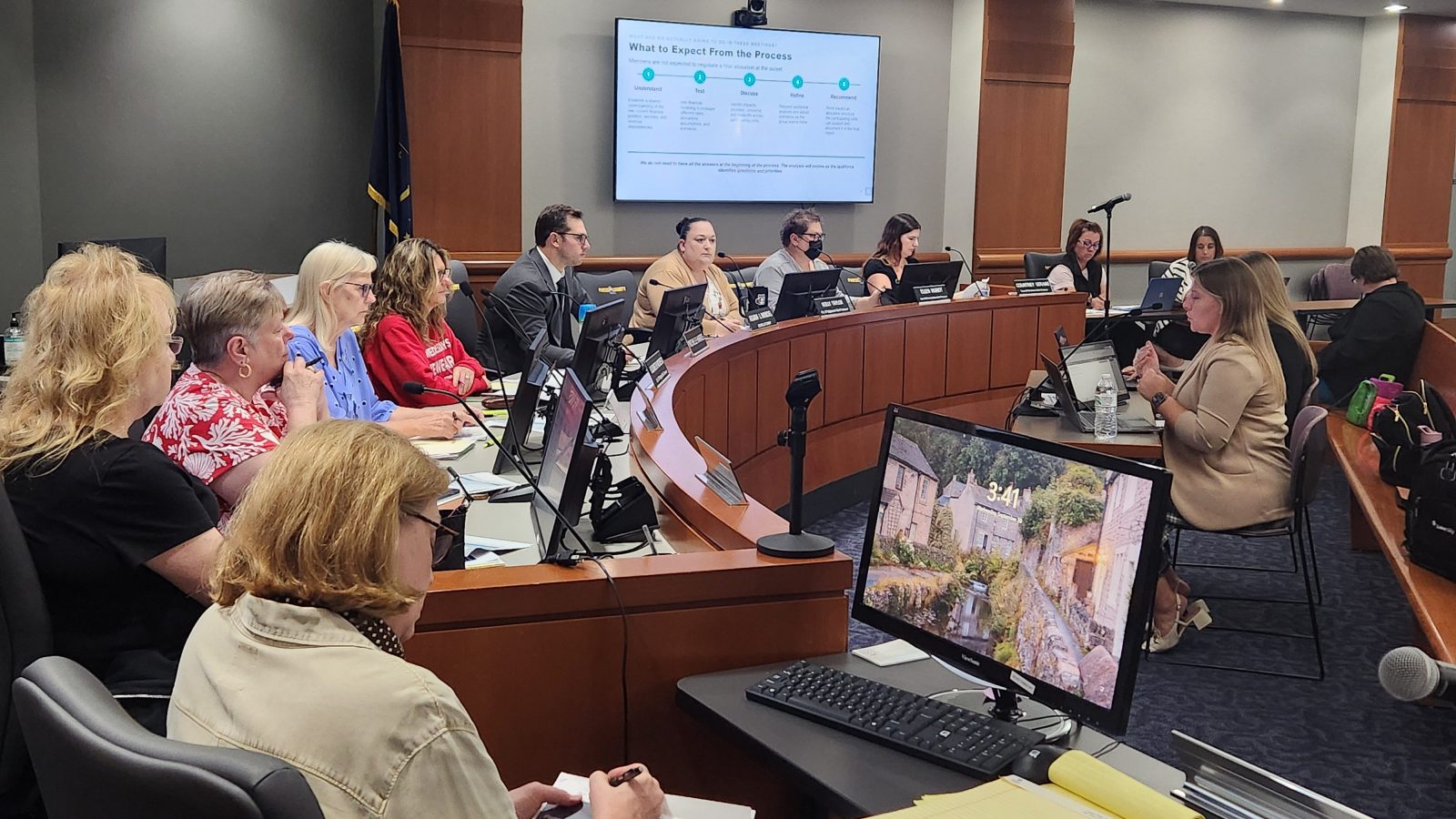
Porter County local municipal leaders have officially convened to address the future of local income tax structures under new state legislative mandates. Porter County’s Municipal Unit Strategic Taskforce (MUST) held its inaugural meeting on Wednesday afternoon, Sept. 30, 2026, launching a compressed timeline to evaluate revenue models, statutory rate caps, and municipal opt-out provisions.
The 12-member taskforce brings together local governance stakeholders, featuring one County Council representative—Councilwoman Michelle Harris—alongside the clerk-treasurers representing every city and town across the county. Convened in response to state statutory requirements, the newly formed group faces an aggressive schedule to draft and submit a formal, non-binding report to the Indiana Department of Local Government Finance by November 2, 2026.
What Changed in Porter County Local Income Tax Planning
The creation of the Municipal Unit Strategic Taskforce was triggered by Senate Bill 1 (SB1), a legislative framework requiring counties across Indiana to convene a MUST by October 1. While state statute allows counties to begin these collaborative meetings as early as June, Porter County kicked off its structured evaluation at the end of September in the Porter County Commissioners Chambers.
The core objective of the taskforce is to analyze how the county and its underlying municipalities will navigate forthcoming structural shifts in local income taxation (LIT). Porter County currently maintains a 0.5% LIT. According to financial presentations, this rate stands as the lowest among all 92 counties in Indiana. Supported by a robust tax base of $7.6 billion, this existing 0.5% rate generates approximately $38 million in county-wide tax revenue.
However, Senate Bill 1 introduces a vastly different landscape of maximum allowable rates and revenue allocation rules. Under the incoming statutory structure, maximum rates include up to 1.2% for county services, 0.4% for fire and EMS provisions, 0.2% for non-municipal units with a strict cap of 0.05% per individual unit type, and up to 1.2% for municipal services. Furthermore, current financial obligations undergo shifting dynamics: while Porter County’s $3.5 million annual contribution to the Regional Development Authority (RDA) off the top of revenue is preserved, an existing $13.5 million allocation in homestead credits is slated for elimination under the new LIT structure.
Context and Municipal Options Under Senate Bill 1
A critical element facing the taskforce involves municipal autonomy. Cities and towns possessing more than 3,500 residents—specifically Hebron, Porter, Chesterton, Portage, and Valparaiso—hold the distinct statutory option to opt out of a unified county LIT structure. Instead, these municipalities can choose to adopt their own independent rate of up to 1.20% dedicated entirely to municipal services.
Baker Tilly Municipal Advisors representative Amber Nielsen provided analytical context during the taskforce’s opening session. Nielsen noted that Porter County is situated in a relatively advantageous position compared to strictly rural counties throughout the state, largely due to its high tax base and strong adjusted gross incomes (AGIs). “Porter County does have a pretty high tax base, which, in a lot of ways, will make the new structure work well in Porter County,” Nielsen stated during the meeting.
Despite these favorable economic fundamentals, the structural transition introduces complex policy and financial questions for local leaders attempting to balance community needs without overburdening taxpayers.
Business and Sector Implications
For local businesses, property owners, and individual taxpayers, the decisions made by the taskforce and individual municipal councils carry direct economic implications. Because municipalities can choose whether to remain under the county umbrella or opt out to establish independent rates, tax burdens could shift unevenly across geographic boundaries.
Amber Nielsen highlighted this potential disparity during discussions, noting that differing municipal rates could cause major differences in what Porter County residents ultimately pay. “Right now everyone pays the same rate. You could have people living across the street paying different LIT rates,” Nielsen explained.
Adding to the fiscal complexity, school corporations face an entirely different reality under the legislation. Nielsen observed that schools are completely excluded from the new LIT buckets, receiving $0 from the framework, which she expects will be a prominent concern reflected across many of the state’s 92 MUST reports submitted to the DLGF.
Timeline and Future Deadlines
While the immediate priority focuses on the November 2, 2026, non-binding report to the Indiana Department of Local Government Finance, the statutory timeline extends further into the decade:
- November 2, 2026: Deadline for the MUST to submit its non-binding report to the DLGF.
- October 1, 2028: Statutory deadline by which municipalities must officially adopt changes to their LIT structures, utilizing 2020 census data.
- 2029: Official implementation year for adopted LIT structure changes.
- 2030: Year when adjusted revenues formally come into play for local units.
The taskforce has scheduled subsequent working sessions to refine its findings and projections, setting meetings for 3 p.m. on Tuesday, Oct. 13, 2026, and Tuesday, Oct. 19, 2026, in the Porter County Commissioners Chambers, with the latter meeting subject to cancellation if deemed unnecessary.
Limitations and Uncertainties
As the taskforce navigates its preliminary mandate, several key uncertainties remain. It is currently undetermined whether individual municipalities will ultimately choose to opt in or out of the county local income tax structure, nor is it certain which specific financial scenarios modeled by Baker Tilly will materialize in practice. Additionally, the exact tax rates that cities and towns will ultimately select remain subject to ongoing debate and municipal-level deliberations.
Local leaders, including representatives from Burns Harbor and other participating jurisdictions, continue to weigh community impacts, striving to determine what rate structures will maintain financial stability without overextending local taxpayers.