
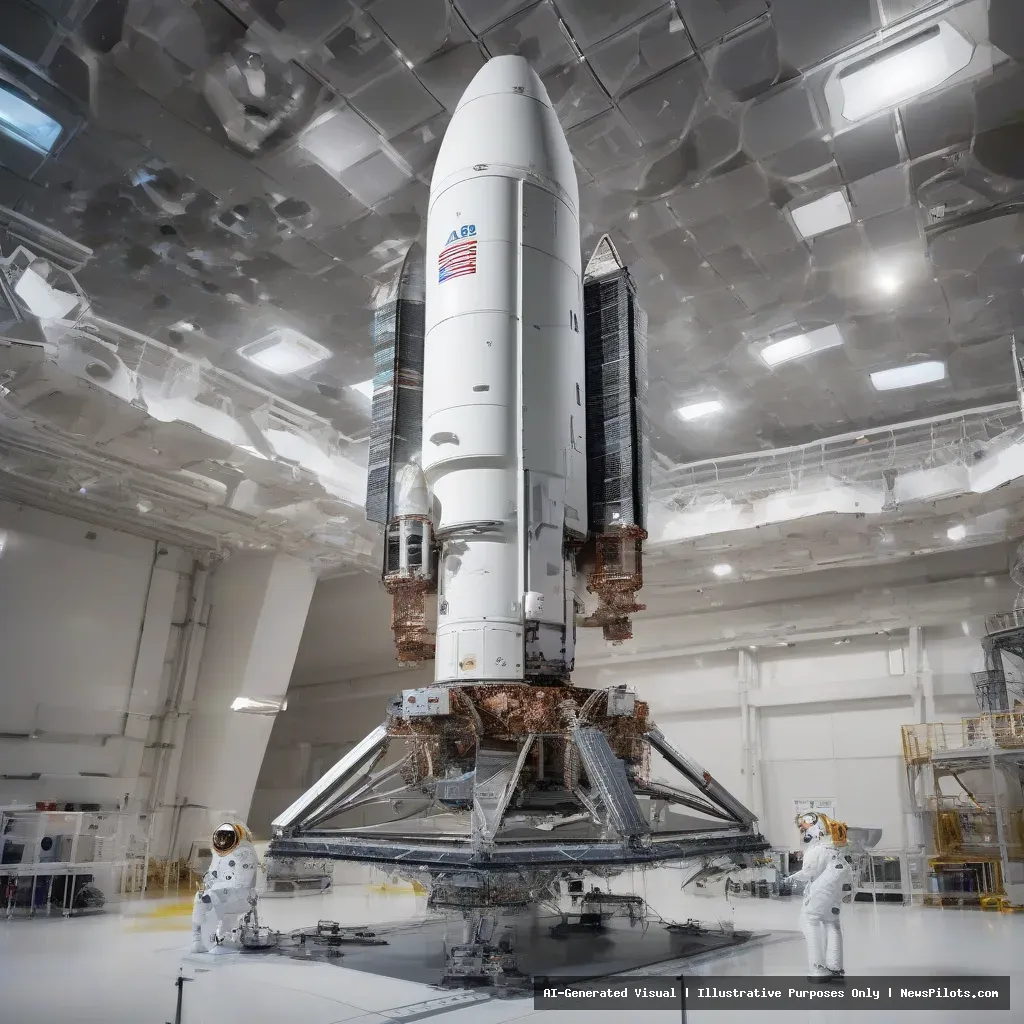
ABB’s Cutting‑Edge Optics Power EarthDaily’s First Processed Imagery
ABB has once again demonstrated its leadership in optical engineering with the successful deployment of its advanced space‑grade instruments aboard EarthDaily’s new Earth Observation Satellite. The satellite’s EDC‑01 payload, which has just released its first set of high‑resolution images, showcases the precision and reliability of ABB’s laser‑based sensing technology. ABB space technology is an important part of the developments covered in this report.
ABB space technology: What It Means and Why It Matters
From Laboratory to Orbit: ABB’s Laser‑Based Isotopologue Sensors
Central to EDC‑01’s performance is a suite of laser spectrometers capable of detecting trace gases with unprecedented accuracy. ABB’s laser‑based isotopologue analysis platform, developed over a decade of research, enables the identification of individual nitrogen‑oxide variants (N₂O isotopologues) in the atmosphere. This capability is critical for monitoring greenhouse gas emissions and verifying compliance with international climate agreements.
Precision Imaging Through Advanced Spectroscopy
The satellite’s imaging system relies on ABB’s expertise in Fourier‑Transform Near‑Infrared (FT‑NIR) spectroscopy. By measuring the absorption spectra of surface materials, the sensors can produce detailed maps of vegetation health, soil moisture, and urban heat islands. The same technology that has been used to characterize polyvinyl alcohol (PVA) in laboratory settings is now delivering real‑world data from orbit.
Recognition of ABB’s Optical Scientists
Two of ABB’s optical research scientists recently joined the elite ranks of the Society of Photomicrography and Imaging Engineers (SPIE). Their selection underscores the company’s role in advancing optical innovation in Quebec and worldwide. The scientists, whose work spans laser stabilization, detector optimization, and data processing algorithms, have directly contributed to the design of EDC‑01’s optical payload.
50 Years of Analytical Excellence
ABB’s journey in analytical solutions spans five decades, during which the company has continuously expanded its portfolio from industrial process control to space‑borne sensing. The latest milestone—EarthDaily’s first processed imagery—highlights the breadth of ABB’s expertise and its capacity to meet the stringent demands of space missions.
Implications for Earth Observation and Climate Science
The high‑precision images released by EarthDaily provide unprecedented detail of atmospheric composition, surface reflectance, and trace gas concentrations. Scientists can now monitor regional pollution events, track methane plumes, and assess the effectiveness of carbon‑capture initiatives with a level of detail that was previously unattainable.
Future Developments and Collaborations
ABB is exploring collaborations with research institutions to further refine laser‑based detection of other greenhouse gases, such as carbon dioxide and sulfur dioxide. Additionally, the company is working on integrating hyperspectral imaging capabilities to enhance land‑cover classification and disaster response efforts.
Conclusion
ABB’s advanced optical technologies have once again proven their value beyond terrestrial applications. By enabling EarthDaily’s EDC‑01 to deliver the first high‑precision satellite imagery, ABB has set a new standard for accuracy and reliability in space‑borne sensing. This achievement not only showcases the company’s technical prowess but also provides a powerful tool for scientists and policymakers working to protect our planet.
Related Articles
- Apple Returns to the Smartphone Spotlight — but Not in Your Pocket
- OpenAI Releases Comprehensive Report on Hugging Face Agent Hack Incident
Original Source: ABB
What Happens Next?
The next phase of this development will be closely watched by industry participants, consumers and policymakers. ABB space technology could influence future technology, business decisions and broader market trends. The practical impact will depend on implementation, cost, reliability, regulatory developments and how quickly the underlying technology evolves.