
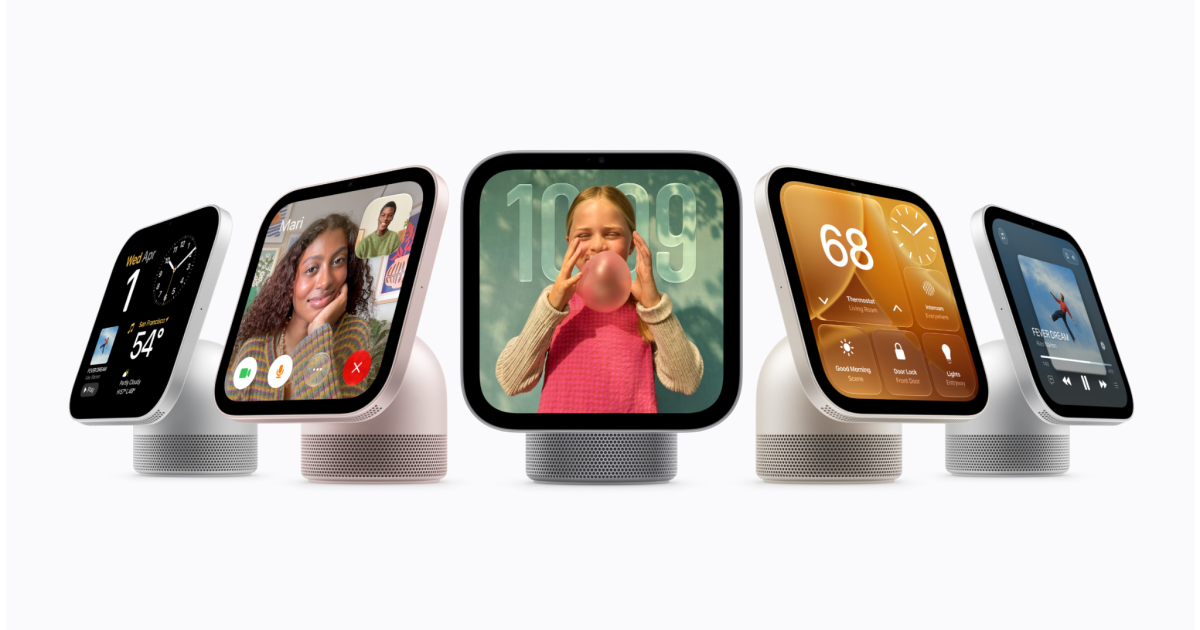
Apple has entered the connected home market with Apple HomeView, a 7-inch smart display designed to manage smart home devices, media playback, and household communications. Priced at US$299, the device aims to bridge the gap between tablet computing and dedicated home automation hardware. Featuring an aluminum tabletop model equipped with a tilting stainless steel hinge, HomeView is available in silver, starlight, rose pink, and space gray. Deliveries are scheduled to begin on November 13.
The announcement expands Apple’s ecosystem footprint into a category long populated by competitors such as Amazon’s Echo Show devices. While Amazon’s hardware already features displays that adapt to viewing distance, Apple’s entry brings its own hardware design language, A18 chip architecture, and deep integration with Apple Intelligence and iCloud+ services. As consumers weigh whether current connected home tech offers compelling new utility, HomeView introduces a mix of advanced proximity sensing, facial recognition, and audio capabilities.
What Changed in Apple's HomeView Announcement
Apple has officially unveiled HomeView after months of industry speculation regarding the company’s connected home strategy. The device is built around a 7-inch Liquid Retina display that supports True Tone technology. The screen is capable of adjusting its brightness dynamically, ranging from a peak of 500 nits down to 0.3 nits for low-light environments.
The hardware is housed in an aluminum chassis with a tilting stainless steel hinge. Apple is offering the tabletop version in four distinct color finishes: silver, starlight, rose pink, and space gray. In addition to the tabletop model, Apple also offers a wall-mounted version, though the necessary mounting hardware and power accessories are sold separately. Deliveries for the device begin on November 13.
Audio engineering is a central component of the HomeView design. The device features two full-range drivers located directly in the display housing, complemented by a down-firing woofer and two force-cancelling passive radiators integrated into its domed base. This hardware setup is supported by computational audio and Spatial Audio processing. However, whether HomeView can project sound around a room in the manner of the original HomePod remains to be heard, as reviewers and users await hands-on audio tests.
Key Benefits and Technical Specifications
Under the hood, HomeView incorporates Apple’s A18 chip, which handles processing tasks locally. According to Apple, sensitive camera and microphone data processing is isolated within protected areas of the A18 chip to maintain user privacy.
The device’s interface features proximity adaptation, meaning it adjusts its layout based on how far away a user is standing. From across the room, the display shows basic, high-level information, transitioning to greater detail as someone approaches. Furthermore, HomeView can recognize up to six individual household members by their faces, presenting personalized information tailored to each user.
For entertainment and communication, HomeView supports Apple Music, Podcasts, Apple TV, compatible third-party applications, and FaceTime calls utilizing Center Stage technology. Whether a 7-inch display is genuinely an ideal medium for watching television programming remains debatable, but the inclusion of Apple TV and third-party apps broadens its utility beyond basic utility control.
Smart Home Control and Security Integration
HomeView functions as a central command hub for connected environments. The device can control compatible smart home accessories, including smart lights, thermostats, window blinds, and door locks. It can also stream security camera feeds.
When paired with compatible equipment and an active iCloud+ subscription, HomeView can recognize people, pets, and package deliveries. A notable security feature is its capability to display up to nine security camera feeds simultaneously on the screen, giving users a comprehensive overview of their property from a single interface.
Business Implications and AI Integration
From a business perspective, HomeView anchors users deeper into the Apple ecosystem while introducing new tiered service models for artificial intelligence. While basic functions are integrated, personal functions that require private data from Messages, Calendar, and other applications necessitate a paired Apple Intelligence-compatible iPhone or iPad.
Additionally, Apple has structured its software capabilities with usage boundaries. Certain server-assisted AI features will come with daily usage limits, with expanded paid access plans intended for introduction in the future. This approach mirrors broader industry trends toward monetizing advanced generative AI capabilities through recurring subscription tiers.
Risks, Limitations, and Uncertainties
Despite its robust feature set, HomeView comes with several operational limitations. The reliance on a paired iPhone or iPad for personal app integration means the device is less autonomous for multi-user households that mix device ecosystems. Daily usage caps on server-assisted AI features may frustrate users who hit thresholds quickly, forcing them to wait or anticipate paid expansion tiers.
Hardware limitations also exist. The wall-mounted version requires purchasing extra mounting accessories, increasing the total deployment cost beyond the base US$299 price tag. Furthermore, technical uncertainties persist regarding acoustic performance in large spaces and the ergonomic viability of a 7-inch screen for media consumption.
Attribution and Outlook
Details of the device were outlined by Apple alongside industry coverage from publications such as New Atlas. Apple states that its A18 chip isolates sensitive processing, and promises that Siri AI will deliver more natural conversations, broader general knowledge, and contextual awareness. As the November 13 delivery date approaches, the market will soon evaluate whether Apple’s latest hardware offering establishes a new standard for connected home displays.