
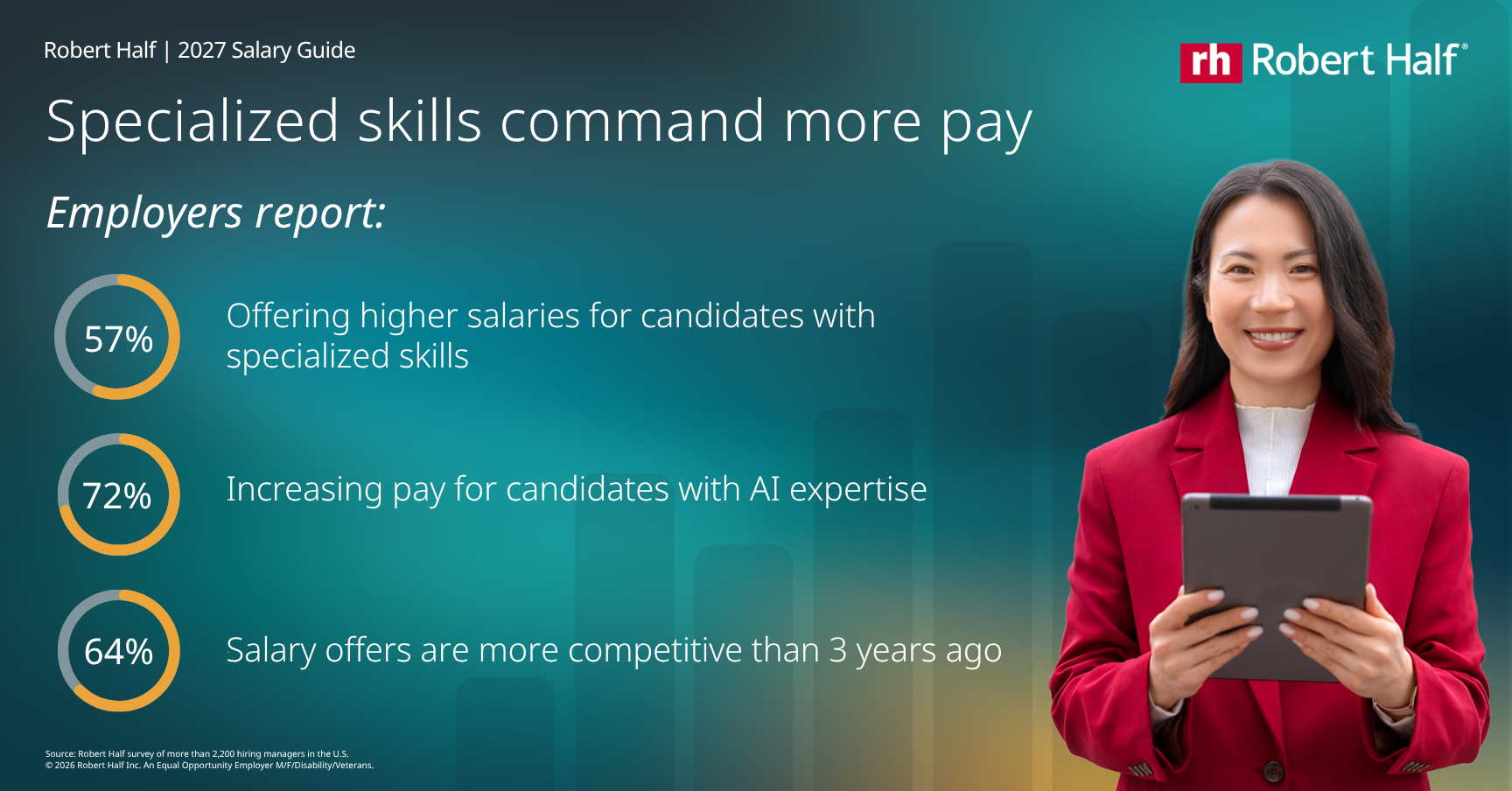
The labor market is undergoing a notable shift toward specialized expertise, according to new data released on October 1, 2026. The 2027 Salary Guide From Robert Half finds employers are paying more for candidates with specialized skills, as businesses navigate tightening competition, evolving compensation expectations, and the rising prominence of emerging technologies across seven professional fields.
Released by Robert Half—alongside Protiviti—the research indicates that hiring landscapes have grown increasingly competitive. Backed by insights from more than 2,000 hiring managers, business leaders, and employed workers, the report highlights a corporate environment where standard compensation packages no longer suffice to secure top-tier talent.
What Changed in the Hiring Landscape
The fundamental change documented in the 2027 report centers on executive willingness to exceed initial budgets to secure crucial talent. Specifically, 57% of managers report that they are offering higher-than-planned salaries to attract new hires. This behavior is directly tied to a scarcity of specialized knowledge.
Job offers have also intensified significantly in speed and aggression. According to the research, 64% of employers say job offers are more competitive today than they were three years ago. Companies are no longer able to maintain rigid salary caps if they hope to secure professionals possessing high-demand capabilities.
Dawn Fay noted in the findings: “Compensation expectations are evolving as employers compete for talent with specialized and emerging skills.” Fay added that “Our Salary Guide gives employers the market insight they need to make informed offers, move quickly on top candidates and build compensation strategies that support their business priorities.”
The Artificial Intelligence Premium
Among all technical abilities, artificial intelligence commands the most aggressive compensation adjustments. The Robert Half data shows that 72% of managers are actively increasing pay for candidates with relevant AI skills. Furthermore, 42% of managers report offering higher compensation for AI-related expertise than for other standard technical competencies.
This trend illustrates how swiftly technological integration alters corporate hiring priorities. As businesses race to implement automation, data intelligence, and machine learning workflows, professionals who bridge the gap between business operations and artificial intelligence find themselves in an advantageous negotiating position.
Geographic Variations in Starting Salaries
Competitive pressures are not felt uniformly across the United States. Certain metropolitan areas exhibit a much higher concentration of employers willing to exceed their planned starting salaries:
- San Francisco leads the nation at 66%.
- Denver follows closely at 65%.
- Seattle ranks third at 64%.
Other major business hubs also report significant activity, with Dallas, Minneapolis, Boston, Atlanta, Washington, D.C., Los Angeles, Houston, New York, and Chicago reflecting broader national shifts where employers must adapt to regional talent shortages and localized cost-of-living adjustments.
Business Implications and Pay Transparency
Beyond basic remuneration, corporate operational strategies around salary disclosures have matured. Pay transparency has emerged as a core operational strategy rather than just a compliance measure. The research shows that 60% of employers find that pay transparency has helped attract higher-quality candidates.
Consequently, corporate adoption of transparency is nearly universal. Today, 96% of employers either include salary ranges directly in job descriptions or plan to do so. According to corporate statements in the guide, salary transparency and market-informed compensation strategies serve as critical hiring differentiators.
When employers provide clarity around pay and align salaries with current market conditions, leadership teams are better positioned to attract talent, retain existing employees, and streamline the recruitment process. Despite these adjustments, overall projections show a modest average increase of 1.9% for new hire salaries across the seven tracked specializations in 2027, highlighting that spending is concentrated on specialized roles rather than broad, across-the-board raises.
Beyond Base Pay: Key Perks Influencing Career Decisions
Base compensation is only one component of modern talent acquisition and retention. Workers evaluating career moves look closely at non-monetary benefits and workplace flexibility. Beyond standard healthcare offerings, professionals highlighted several key perks influencing their career decisions:
- Flexible work hours: Cited by 67% of workers.
- Commuter benefits: Cited by 55% of workers.
- Hybrid work arrangements: Cited by 51% of workers.
- Free or subsidized meals: Cited by 51% of workers.
- 401(k) matching programs: Cited by 50% of workers.
These preferences indicate that while specialized skills command higher financial compensation, work-life integration and daily workplace conveniences remain vital factors in employee decision-making.
Limitations and What to Watch Next
While the data provides a comprehensive look into corporate compensation trends for 2027, hiring managers must continuously monitor shifting macroeconomic conditions. As compensation models adapt to specialized talent scarcity, organizations face the ongoing challenge of balancing higher labor costs with broader business sustainability. Observers will watch whether the 1.9% average projected salary growth holds true as the year progresses and how heavily enterprises continue to weight artificial intelligence credentials over traditional experience.