
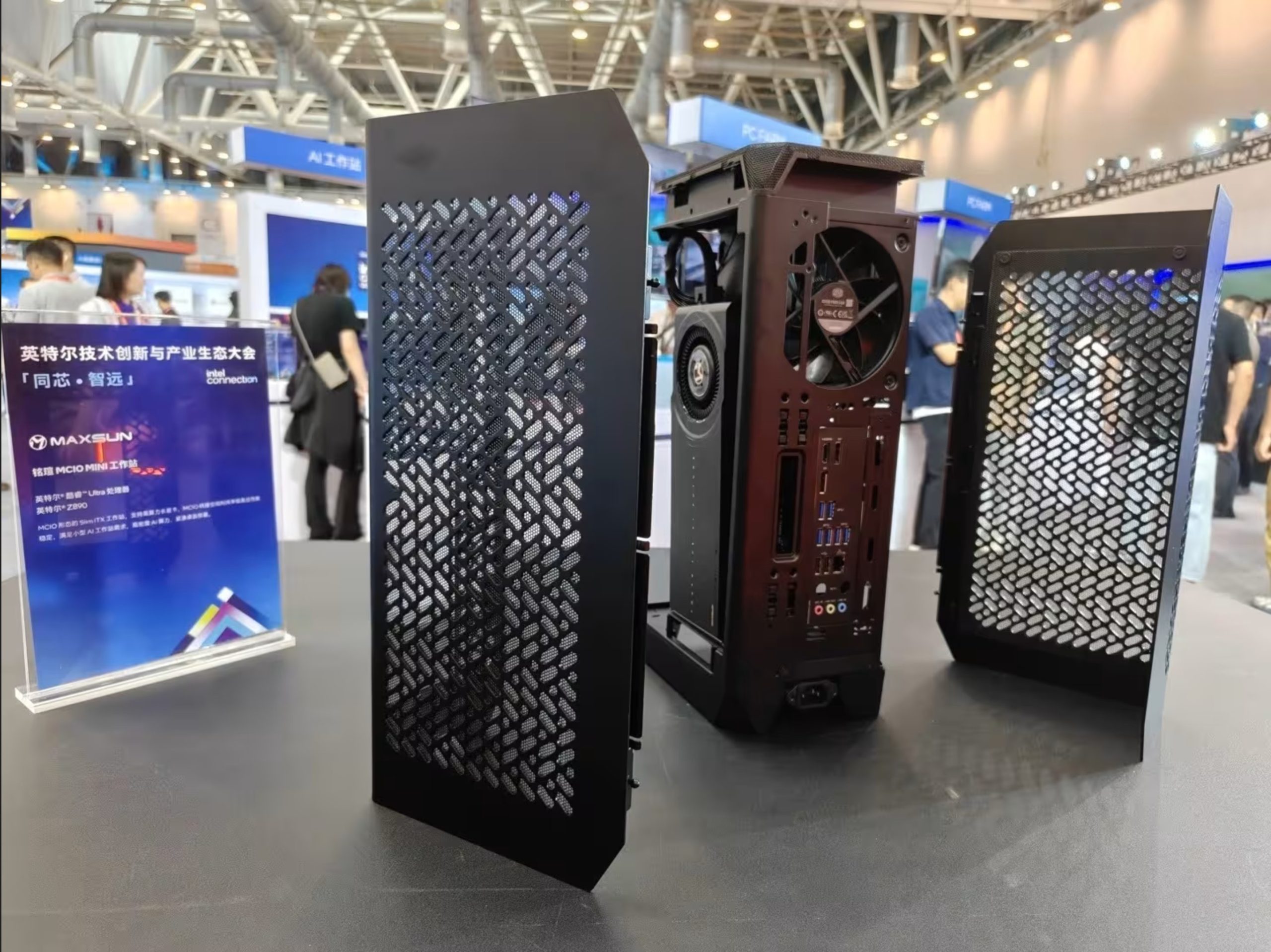
Maxsun showcased a new Z890 Mini-ITX workstation utilizing an MCIO GPU connector at the Intel Connection 2026 conference in Suzhou, China. Motherboard manufacturers constantly look for innovative ways to design hardware for smaller enclosures without sacrificing component performance. By incorporating Mini Cool Edge I/O technology directly into a desktop motherboard, Maxsun provides a hardware layout that alters how graphics cards interface with compact systems.
What Changed
Maxsun demonstrated a compact workstation system built around a mini-ITX Z890 motherboard supporting Intel Arrow Lake-S processors. This motherboard was coupled with an Intel ARC Battlemage GPU inside a Cooler Master i100 Air chassis featuring a vertical orientation. Additional hardware components included a Cooler Master Hyper 510 low-profile CPU cooler and an SFX Gold power supply unit.
The defining hardware modification in this demonstration is the use of an MCIO (Mini Cool Edge I/O) connector for the graphics card. Traditionally, consumer graphics cards plug perpendicularly into a standard PCIe slot directly on the surface of a motherboard. Maxsun’s implementation allows the GPU to be placed parallel to the motherboard instead. This spatial reconfiguration helps reduce the overall footprint and depth required for high-performance compact systems.
Context and Background
Amphenol initially developed the MCIO standard in 2021 as a high-speed internal PCI wiring standard intended primarily for storage solutions. Over time, industry engineers recognized its potential for routing high-bandwidth signals in alternative hardware layouts.
Maxsun is among the first consumer motherboard makers to implement the MCIO standard and adapt it specifically to GPU solutions. Earlier this year in June, Maxsun presented MCIO motherboards specifically designed for mini PCs. Building on that foundation, the system showcased at the Intel Connection 2026 conference targets compact workstations that require significantly more powerful graphics hardware.
Technical and Business Explanation
From a technical perspective, the physical connector handles high-speed data routing across specialized cabling. Maxsun’s current lineup offers mini PC motherboards featuring MCIO connectors in x8+x8 or x8+(x4+x4) PCIe 5.0 lane configurations. Looking ahead, Maxsun has indicated plans to implement PCIe 6.0 solutions soon.
This technology alters traditional desktop engineering principles. By moving away from rigid, direct-slot motherboard layouts, hardware engineers gain spatial flexibility. This flexibility enables manufacturers to build smaller, more streamlined workstation towers that can still house capable processing units and dedicated graphics cards.
Key Benefits and Sector Impact
The primary advantage of adopting an MCIO layout is the dramatic reduction in physical volume for desktop configurations. Traditional mini-ITX builds often struggle with component clearance, particularly when pairing bulky enthusiast-grade graphics cards with large cooling solutions.
By placing the GPU parallel to the motherboard, chassis designers can optimize internal airflow and reduce the z-height or total volume of small form factor cases. This development impacts the compact workstation sector by making high-density computing hardware more practical for professional environments with limited desk space.
Risks, Limitations, and Uncertainties
Despite the architectural potential, several limitations and missing details surround the technology. Most notably, exact pricing and commercial availability information for Maxsun’s MCIO motherboards have not yet been disclosed. Consumers and system builders cannot yet purchase these components or evaluate their market cost.
Furthermore, while Maxsun is recognized as an early adopter, industry-wide support for MCIO-based GPU connections remains in its formative stages. Mainstream chassis ecosystems and power supply configurations are largely engineered around traditional perpendicular PCIe placement, meaning early adopters may face hardware ecosystem constraints.
Business Implications and Who May Be Affected
System integrators focusing on small form factor PCs stand to benefit significantly if parallel GPU mounting becomes standardized. Professional users requiring dense workstation power in portable or space-constrained setups will find these layouts appealing.
Conversely, traditional component manufacturers who rely on conventional motherboard dimensions and riser cable ecosystems may need to adapt their enclosure designs to accommodate parallel MCIO routing. As Maxsun prepares its future hardware iterations, market adoption will depend heavily on broader component availability and pricing.
What to Watch Next
Industry observers should monitor upcoming product announcements from Maxsun regarding official release dates and retail pricing for the Z890 Mini-ITX MCIO motherboards. Additionally, tracking the commercial rollout of their planned PCIe 6.0 solutions will provide insight into how quickly this high-speed cabling standard matures for consumer and workstation graphics applications.