
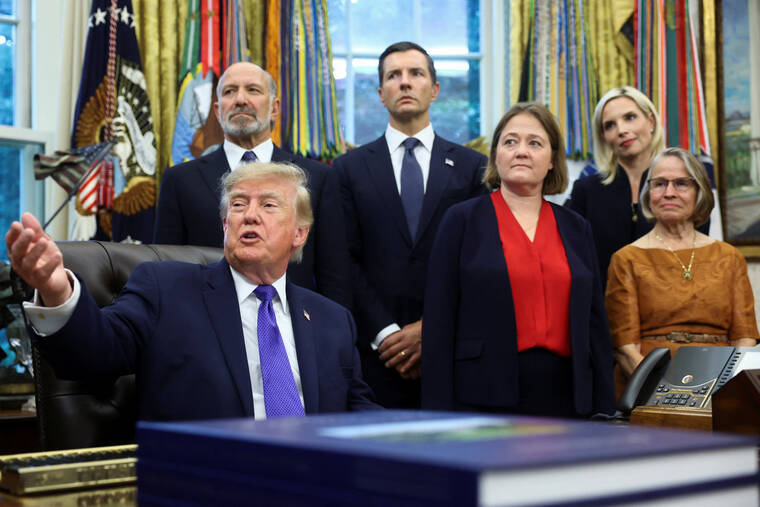
President Donald Trump announced a $15 billion planned Iowa steel project during an Oval Office event at the White House on September 28, 2026. The major industrial initiative will be undertaken by Minnesota company Mesabi Metallics, which is owned by the Indian conglomerate Essar Group. According to descriptions provided by the White House, the planned facility is slated to become the largest steel plant in United States history.
What Changed
During the high-profile White House announcement, President Trump detailed plans for Mesabi Metallics to construct a massive steel mill in Iowa. The project features a fully vertically integrated supply chain, utilizing iron ore extracted directly from Minnesota to produce finished steel in Iowa. Prominent attendees at the Oval Office unveiling included U.S. Commerce Secretary Howard Lutnick, U.S. Export-Import Bank Chairman John Jovanovic, U.S. Representative Mariannette Miller-Meeks, and U.S. Representative Ashley Hinson.
Mesabi Metallics recently achieved a significant milestone by opening Minnesota’s first new iron ore mine in 50 years, located in Nashwauk, Minnesota. Essar Group has invested more than $2.5 billion into the development of the Minnesota mine to date. Furthermore, the U.S. Export-Import Bank stated earlier in the month that it would finance $10 billion for the mine’s subsequent expansion, laying the foundation for the raw material supply chain required for the new manufacturing complex.
Business Implications and Economic Impact
The scale of the capital expenditure and operational footprint carries substantial economic consequences for the region and the broader domestic industrial sector. The first phase of the planned Iowa steel project will produce 7.5 million tons of steel annually. Over subsequent operational phases, the plant’s output is eventually expected to reach 10 million tons per year.
Project planners and administration officials anticipate that the first phase will generate $95 billion in total economic impact during the construction timeline and its first 10 years of operation. Industry analysts note that commercial electricity prices in Iowa are marginally lower than in Minnesota, a factor that may relate to ongoing production costs, though analysts point out that multiple complex operational variables remain involved in a facility of this magnitude.
Sector Impact and Market Context
Global steel markets have faced sluggish conditions due to persistent overcapacity—particularly in China—and lackluster international demand. Conversely, domestic U.S. steel prices have remained higher as a result of existing trade barriers.
By establishing a domestic, vertically integrated pipeline connecting iron ore extraction directly to finished steel production, the venture seeks to secure raw material availability entirely within domestic borders. Highlighting the administration’s enthusiasm for the manufacturing initiative, the White House described the investment using the phrase, “This is a tremendous investment,” and stated that “Our steel industry is roaring back to life.”
Who May Be Affected
Workers, local communities, and regional economies across Minnesota and Iowa stand to be directly impacted by the development and its extensive supply chain. The facility is expected to create at least 1,750 permanent jobs once operational. Additionally, the initiative is projected to support up to 6,000 construction jobs during the initial phase of development, driving localized economic activity in both states.
Limitations and Uncertainties
Despite the considerable scale and scope of the official announcement, several operational questions and logistical details remain unverified. It was not immediately clear why Mesabi aims to build a massive steel mill in Iowa using iron ore extracted from Minnesota, traversing the significant distance between the two regions when other geographical configurations could theoretically be considered. Additionally, representatives for Mesabi Metallics were not immediately available to comment on the operational specifics or logistics following the White House disclosure.
What to Watch Next
With first steel production expected to commence in 2030, industry observers will carefully track financing milestones, permitting approvals, and construction kickoffs over the coming years. Implementation of the $10 billion financing commitment from the U.S. Export-Import Bank for the Nashwauk mine expansion will serve as a primary indicator of project momentum as long-term planning moves forward.